Nattapong Ruangpanyawut refuses to apologise over “blue regime” claims as Senate threats and legal warnings escalate. Prime Minister Anutin dismissed the allegations as just political rhetoric while DSI and the Election Commission Senate election probes have stalled.
Nattapong Ruangpanyawut, leader of the People’s Party and Thailand’s opposition, has refused to apologise for claims of a “blue regime” consolidating power, triggering a widening political confrontation across Parliament, the Senate, and national oversight bodies. His May 22 remarks have escalated into legal threats from up to 90 Senators, direct albeit mild pushback from Prime Minister Anutin Charnvirakul and renewed scrutiny of alleged links between 139 Senate members and ruling-party interests. With investigations by the Department of Special Investigation and the Election Commission stalled, the dispute has hardened into a high-stakes clash over institutional legitimacy, constitutional reform and allegations of concentrated political control ahead of key elections and a disputed constitutional rewrite.
The leader of the People’s Party and the opposition has again refused to apologise in the face of legal threats. These came on Monday from 89 conservative senators. He reiterated his stance on comments made on May 22. He referred to what he described as a “blue regime” in Thailand. Moreover, he said he has no reason to withdraw the remark.
In addition, he stressed that his wording refers to a political grouping. He insisted it does not target individuals personally. Furthermore, he maintained that it describes a broader structure of power. He repeated this position in late May 2026 statements.
Meanwhile, he appeared link the “blue” political association in Thailand to the Bhumjaithai Party. He said the association is widely recognised in political discourse. The party emerged after the February 28 General Election. It now holds ruling-party status in government.
Prime Minister’s return and Senate threats escalate political tensions over ‘blue regime’ allegations
However, he did not soften his position under pressure. Instead, he repeated it in Parliament on May 27. He said the term reflects concentrated political influence. Moreover, he said it reflects structural control in governance.
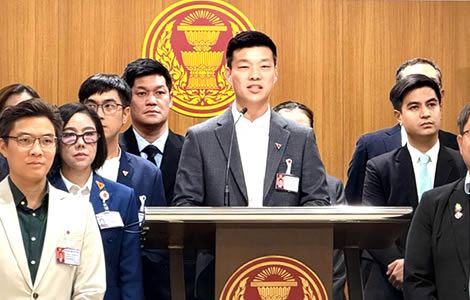
At the same time, pressure escalated from the Senate. Up to 90 conservative Senators threatened legal action. They objected to his repeated use of the phrase “blue regime.” Subsequently, the dispute shifted from rhetoric to legal warnings.
However, the Senators did not publicly outline detailed charges. Instead, they issued general threats of legal proceedings. Meanwhile, political tension widened across institutions. It moved from Parliament into oversight agencies.
In parallel, Prime Minister Anutin Charnvirakul responded publicly. This followed the Prime Minister’s return from Parliament on Wednesday. Mr Anutin has led the Bhumjaithai Party to electoral success in three elections. He dismissed the allegations as normal political rhetoric. Certainly, he has previously underlined that he has no links with members of the Senate. In addition, he made it clear there would be no legal counteraction.
Investigations into Senate allegations and constitutional fears deepen national political divide
Meanwhile, the dispute continued to expand politically. It reached Parliament, the Senate, and oversight bodies. As a result, the issue has long been simmering as a national political flashpoint. Moreover, the General Election win by the Bhumjaithai Party has intensified debate over institutional legitimacy.
At the same time, attention focused on 139 Senate members. Critics allege links between those Senators and ruling party interests. These claims remain politically contested. Furthermore, they continue to circulate in parliamentary debate.
In addition, investigations have added institutional weight. The Department of Special Investigation is reviewing related issues. These concerns substantiate allegations of collusion and a concentrated conspiracy to control the 2024 Senate election. The Election Commission of Thailand is also involved. At one stage, the Election Commission reportedly recommended court proceedings against the Senators involved and senior figures within the Bhumjaithai Party.
However, those proceedings have not moved forward. They could ultimately involve Senators and party executives. Nevertheless, no formal judicial action has been confirmed. As a result, the cases are widely described as stalled.
Constitutional reform debate intensifies amid fears of a more restrictive charter replacement
Consequently, political pressure has continued to build. The issue is now described as urgent in parliamentary discussions. Moreover, it continues to influence national political alignment. It also overlaps with the constitutional reform debate.
Meanwhile, constitutional change discussions remain active. A new constitution is under consideration. It would replace the 2017 Charter. In addition, the 2017 Constitution remains widely criticised.
Furthermore, critics say it contains structural weaknesses. It is frequently cited in reform discussions. Moreover, it remains central to political debate on governance design. The dispute has now been linked directly with constitutional reform.
Indeed, there are real fears that the ruling party may move to push through an even more conservative Charter.
At Parliament on May 27, Nattapong restated his position clearly. He said, “I don’t think I need to apologise for anything.” Moreover, he said he stands by all his statements. He also said he is prepared for legal proceedings.
Nattapong defends ‘blue regime’ claim and rejects allegations over national flag interpretation
In addition, he clarified the meaning of “blue regime.” He said, “I maintain that everything I said was factual.” He also said, “I didn’t allude to any specific individual.” Moreover, he insisted the phrase describes a political structure.
At the same time, he rejected alternative interpretations. He said he never referred to the National Flag. He asked, “Have you ever heard me say that the term ‘blue regime’ refers to the colours on the National Flag?” Moreover, he said such claims are slander.
Meanwhile, he called on citizens to interpret his remarks themselves. He said it is up to individuals to assess political reality. Furthermore, he linked this to governance concerns and public experience. He said citizens must judge based on conditions they observe.
In addition, he referenced Government anti-corruption commitments. He said the Prime Minister has announced decisive action. However, he said corruption indicators continue to rise annually. Moreover, he pointed to worsening conditions in governance.
Economic pressure claims, ministerial exchanges and constitutional reform dominate parliamentary debate
At the same time, he said private-sector costs are increasing. He said businesses are paying higher contributions to government processes. Furthermore, he linked this to systemic governance issues. He said it reflects structural inefficiency.
Subsequently, he addressed remarks from Minister Paradorn Prisnanantakul. Paradorn said the “blue regime” claim was divisive rhetoric. However, Nattapong rejected that interpretation. He said, “It could be considered political retaliation.”
Moreover, he said political exchanges of this kind are common. He stated he does not wish to escalate hostility. Instead, he said he prefers to focus on structural reform. He returned repeatedly to constitutional change arguments.
In addition, he said elections alone are not sufficient. He said, “The real solution is to reform the country’s supreme law.” Furthermore, he said, constitutional drafting is essential to democracy. He linked this to institutional accountability.
MoA agreement, election outcome and referendum demands shape constitutional reform positioning
At the same time, he referenced a Memorandum of Agreement. He said it was signed to advance constitutional drafting. Moreover, he said it prioritised national interest over party interest. He added it supported reform commitments.
Meanwhile, he referred to the February 8, 2026, election outcome. He said the result could not be predicted at the time. However, he said the outcome must now be accepted. Moreover, he called for political adaptation.
In addition, he said the People’s Party remains committed to reform. He said, “We will do everything we can to find a way out for the nation.” Furthermore, he said they will operate within the current system. He stressed continued political engagement.
At the same time, he reiterated the referendum requirement. He said constitutional changes must be approved by the public. Moreover, he said voters must decide on the final draft proposals. He emphasised legitimacy through public consent.
Senate legal pressure continues as Bangkok election dynamics and candidates are discussed
Furthermore, he outlined conditions for support. He said, “If it is accountable, we are ready to support it.” However, he said they would reject monopolised systems. Moreover, he stressed rejection of special privilege structures.
Meanwhile, he referred to a Constitutional Drafting Assembly. He said it must be closely linked to the people. Furthermore, he said it must ensure broad participation. He linked this to democratic legitimacy.
At the same time, legal pressure from Senators continued. Up to 90 Senators maintained threats of legal action. They cited his repeated public statements. However, no official court filings were confirmed publicly.
Nevertheless, Nattapong refused again to apologise. He said, “I maintain that what I said was factual.” Moreover, he said he is prepared to face legal action. He added that he is ready to clarify in court.
In addition, he rejected claims that he targeted individuals. He said, “I didn’t allude to any specific individual.” Furthermore, he said his comments concern institutions, not persons. He described them as normal political expression.
Nattapong refuses an apology and denies targeting individuals amid legal action and silencing claims
Meanwhile, he challenged critics directly. He asked whether citizens would be silenced by legal threats. Moreover, he questioned whether criticism would be criminalised. He linked this to broader democratic concerns.
At the same time, he said he is acting as a citizen and politician. He said he is speaking within national rules. However, he rejected claims of wrongdoing. He insisted his statements remain within political boundaries.
Meanwhile, attention turned to Bangkok electoral dynamics. He acknowledged such interpretations are possible. Moreover, he said voting behaviour differs across elections. He avoided making direct electoral predictions.
In addition, he expressed confidence in his Bangkok network. He cited 50 Bangkok Metropolitan Council members. Furthermore, he highlighted organisational strength in the capital. He said it supports campaign readiness.
Bangkok election focus as Nattapong cites council strength. Backs Chaiwat Sathavorawichit in June 28 poll
At the same time, he named Chaiwat Sathavorawichit as a candidate. He said, “He is another excellent option.” Moreover, he compared him to other leading contenders. He referenced the June 28 election.
However, he said voters will decide the outcome. He emphasised democratic choice at the ballot box. Furthermore, he described the election as a key moment for Bangkok.
Hard working and under pressure Prime Minister Anutin returns from France to a packed schedule and issues at home
Tussle between People’s Party leader and Senate band as Nattapong Ruangpanyawut refuses to apologise
Opposition and People’s Party leader attacks ‘blue regime’ on the 12th anniversary of the 2014 coup
Finally, he returned to the central dispute. He rejected claims linking him to National Symbols. Moreover, he said such allegations are inaccurate. He described them as politically motivated interpretations.
Finally, he repeated his stance clearly. He said he will not apologise. Moreover, he said the “blue regime” description reflects his assessment. He added that the public will ultimately decide its validity or not.
Join the Thai News forum, follow Thai Examiner on Facebook here
Receive all our stories as they come out on Telegram here
Follow Thai Examiner here
Further reading:
PM and Macron discuss visa-free access for Thai nationals in the European Union’s Schengen zone
Economy faces export clogs with rules in China and ‘green imperialism’ from European Union
Vital European Union free trade deal with Thailand with stiff demands from Brussels to take time
World’s biggest free trade deal just signed will be a huge boost for the Thai economy and exports