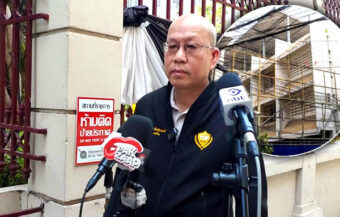
Police rescue a 75-year-old woman from scammers in Bangkok, intercepting her before she handed over savings, highlighting the alarming scale and sophistication of call center gangs targeting elderly Thais and threatening billions in lost funds nationwide.
A fast and precise Metropolitan Police operation, using expert detectives, intercepted a 75-year-old woman before she handed over her savings to an online scam gang on Saturday. She was found at a bank counter, making her fourth and largest withdrawal to meet the gang’s demands. Convinced she was being monitored, she feared prosecution if she disobeyed. The scale and cunning of these scams are alarming, posing a serious threat to the savings of ordinary Thais. Particularly concerning is the scammers’ ability to single out and target vulnerable individuals.

An intensive and coordinated police operation unfolded in Bangkok on Saturday after relatives reported a suspected call center scam in progress. The response was led by the Metropolitan Police Bureau and executed through Yannawa Police Station.
At the center of the case was a 75-year-old woman, identified as Ms. Inthira, whose family believed she was under the direct control of scammers. Because of the urgency, the case escalated quickly within the police command.
Earlier that day, Ms. Inthira left her home in the Charoen Krung area without notifying her family. According to investigators, she was acting under strict instructions from a caller impersonating a police officer. The caller used intimidation and repeated threats. As a result, she was ordered to present the money for ‘verification’ immediately. She was also warned not to speak to anyone. Consequently, all communication with her family abruptly stopped.
Police respond quickly after elderly woman is controlled by scammers and leaves home under strict instructions
Meanwhile, her son, Mr. Apichat, tried repeatedly to contact her by phone. When those attempts failed, concern escalated. Therefore, he went directly to Yannawa Police Station to file an urgent report. Police treated the complaint as a live incident.
Shortly afterward, at around 1:40 p.m., Mr. Apichat briefly reached his mother by phone. However, the call was short and unclear. She only gave spurious information on her location. Background sounds suggested she was inside a room. At that point, investigators concluded she was being actively controlled.
Following that call, officers began immediate analysis of the available information. They focused first on hotels in nearby districts.
As a result, checks were launched across multiple locations. Investigators soon identified that Ms. Inthira had temporarily checked into a hotel in the Sathorn area. However, staff confirmed she had already checked out. According to records, she had left by taxi. Consequently, police shifted focus to tracing the vehicle’s route.
Police leadership mobilises top units to track and intercept elderly woman under a scam gang’s control
At the same time, senior leadership was informed. Orders were issued from the top of the Metropolitan Police Bureau. The case was elevated due to the risk of imminent financial loss. Oversight included Pol. Lt. Gen. Siam Boonsom, Commander of the Metropolitan Police Bureau, and Pol. Lt. Gen. Nophasil Phoolsawat, Acting Commander. In addition, senior officers from Police Division 6 were deployed to support the investigation.
Operational control was assigned to Yannawa Police Station. The investigative team was led by Pol. Lt. Col. Arthit Chatinakrob, Deputy Superintendent of Investigation. He was supported by Pol. Lt. Col. Kitphat Pongphatnakitja and Pol. Lt. Col. Suphakit Kongchuen, both serving as chiefs of investigation. Together, they coordinated field officers and intelligence checks in real time.
As the investigation progressed, police traced the taxi route using available information. The route pointed toward the Rama 3 area. Consequently, officers were dispatched to shopping malls and commercial centres nearby. Teams arrived and fanned out across the locations. Shortly afterwards, Ms. Inthira was located standing at a bank counter. At that moment, she was attempting to withdraw funds.
Officers stop withdrawals at bank counter and prevent the elderly victim from losing funds to scammers
Investigating officers immediately identified themselves. They stopped the transaction before it was completed. Then, they spoke directly with Ms. Inthira. According to police, once the situation was explained, her anxiety subsided. The influence of the caller appeared to end at that point. Officers confirmed that she had already withdrawn money earlier in the day.
Initial checks revealed that Ms. Inthira had withdrawn cash from three Krung Thai Bank accounts. The total amount withdrawn was ฿13,000. This figure is significant. It matches the national average reported loss per scam victim.
Meanwhile, another withdrawal was already in progress. She was about to withdraw an additional ฿26,000 from the Government Savings Bank. However, police intervened before the transaction could be completed. Consequently, further losses were prevented.
Following the intervention, officers escorted Ms. Inthira away from the bank. She was taken to Yannawa Police Station for her safety. There, investigators gathered further details about the scam. At the same time, relatives were contacted. Shortly afterwards, her family arrived at the station. She was then taken home. Police confirmed no additional transactions occurred.
Saturday’s operation demonstrated speed and skill needed to prevent further financial losses to scams
The rescue took place on Saturday, December 13, 2025. Police described the operation as successful and time-critical. The case involved a moving victim, multiple locations and ongoing financial risk. Investigators said rapid reporting by the family was a key factor. Without early notification, further withdrawals were likely.
Importantly, police stated that the method used against Ms. Inthira was not unusual. Call centre scams remain widespread across Thailand. Increasingly, scammers impersonate police officers or other government officials. Victims are told they are under investigation. They are instructed to move money for “verification.” They are also warned not to contact relatives.
Moreover, investigators report that many scam networks appear to possess accurate personal data. In several cases, callers know names, addresses, and identification details. As a result, targets often comply quickly. This tactic increases speed and reduces hesitation. Elderly victims are frequently selected because they often hold savings.
National data highlights the scale of call centre scams and the impact on Thai financial security
National data illustrates the scale of the problem. Recent estimates suggest that people in Thailand lose around ฿110 billion to scams in a single year. However, authorities believe the true figure is higher. Many victims never report incidents. Embarrassment and fear often prevent disclosure. Consequently, official figures may understate the impact.
Earlier studies support this assessment. A report by the Global Anti-Scam Alliance estimated that up to 60 percent of Thai adults have been scammed. This figure reflects both successful scams and attempted fraud. Similarly, an official survey conducted in early 2024 found that 36 million people had been targeted. According to that survey, more than half were reported to have fallen victim.
Despite ongoing enforcement efforts, scam activity remained high under the last Pheu Thai–led government. Oversight during that period fell under the Ministry of Digital Economy and Society. The ministry was led by Prasert Chantararuangthong. However, reductions in overall scam activity were limited during that time.
New government sees surge in call center scams while cracking down on networks abroad
The last Pheu Thai–led government under Prime Minister Paetongtarn Shinawatra was only partially successful at curbing the threat. Nevertheless, since the new government took office in September, there has been a surge in scam centre activity. This comes at the same time as US and UK authorities have begun crackdowns targeting the menace believed to be centred in Cambodia.
Losses recorded between January and February 2025 dropped by 30 per cent compared with the same period in 2024. Authorities linked the decline to regional enforcement actions. Specifically, the government moved to cut electricity and logistical support to scam networks operating in Myanmar and Cambodia. Thailand also tightened control over bank accounts and internal transfers. These actions disrupted some operations.
Certainly, the new government under Prime Minister Anutin Charnvirakul has announced aggressive efforts to freeze assets held by scammer interests in Thailand.
However, there appears to be a surge in scamming activity targeting Thai people. Undeniably, the threat remains extensive. Thailand is a developing, mid-level income country. In that context, the average reported loss of ฿13,000 represents a significant sum. For many households, such losses cannot be easily absorbed. The Bangkok case illustrates how quickly funds can be drained.
Elderly citizens remain high-risk targets and require a rapid police response to prevent losses
Elderly citizens remain frequent targets. They are often less familiar with scam techniques. They may also be more vulnerable to authority-based threats. As a result, police say cases involving elderly victims often escalate quickly. The speed of response becomes critical.
Police repeatedly emphasise to the public that genuine officers do not ask citizens to transfer money by phone. There is no policy allowing financial verification through calls. These facts were restated during the handling of the case. Authorities stressed that any such request should be treated as suspicious.
The Bangkok rescue highlights the pace and coordination required to stop active scams. It also shows the level of resources needed once a victim is already moving between locations. The incident involved family reporting, hotel checks, taxi tracing, and bank intervention. Each step occurred within hours.
For investigators, the case reinforced known patterns. Scammers isolate victims. They apply pressure. They move targets quickly across banks. Once control is broken, victims often realize the deception. By then, losses may already have occurred.
Intervention before largest withdrawal prevents further losses and exposes a wider national scam problem
In this instance, intervention came before the largest withdrawal. Police credit rapid reporting and immediate escalation. The operation prevented further losses and ended the scam. However, authorities acknowledge that many similar cases go unreported. The Bangkok case stands as one documented example within a much larger national problem.
Money Laundering Office seizes assets with money trail linked to South African financier Ben Smith
Cyber police and Money Laundering agency seek UK and US co-operation targeting Cambodian networks
Chiang Mai Police act after noting suspicious transfer saving young woman ฿800,000 sent to scammers
The resurgence of the threat in recent months and the ability of these gangs to target those with savings in Thailand are deeply concerning. For instance, the average bank account balance in Thailand is only ฿3,164. Basically, these gangs know the hard-working Thais who have savings and enough funds to justify their exploits.
The country’s bank deposits in total are ฿17.7 trillion, with 90% of accounts having less than ฿50,000. This includes businesses and the accounts of Thailand’s ultra-wealthy. With current reports of ฿110 billion a year being lost, this threat is a significant one for the country’s economy.
Join the Thai News forum, follow Thai Examiner on Facebook here
Receive all our stories as they come out on Telegram here
Follow Thai Examiner here
Further reading:
Money Laundering Office seizes assets with money trail linked to South African financier Ben Smith
Kla Tham MP dismisses unproven scam centre claims about Deputy Prime Minister Thamanat Prompow
People’s Party warns Anutin of a No Confidence move over cabinet links to Cambodian scam networks
United States, South Korea and United Kingdom act against Cambodian scam industry with Thai tie-ins
Ben Smith affair & allegations of links to Cambodian scam centres continues to rage in parliament
Defiant Rangsiman Rome warns he’s not just fighting a defamation case but for the future of Thailand
Ben Smith money fixer to the elite in Thailand lines up ฿100M defamation case against Rangsiman Rome
Leader of deadly scam gang in Cambodia and henchmen still at large with 4 more Thais arrested
Police in Cambodia close in on fake scam loan app leadership after family murders in Samut Prakan
Cambodian cybercrime industry run by Chinese criminals could be generating up to 38% of its GDP