
Thai police smash cross-border scam links in Mae Sot, uncovering illegal internet transmissions beamed into Myanmar. Raids near the Friendship Bridge expose routers, antennas and shared signals as authorities tighten the net on regional scam gangs.
A raid on several commercial buildings in the western Thai town of Mae Sot on Monday uncovered internet transmission facilities sending signals across the border to Myawaddy. The Myanmar border town is a major scam centre hub opposite Mae Sot in Tak Province. Police identified the targets after a national telecommunications operator flagged massive bandwidth usage at the sites. The facilities were neutralised during the raids, which form part of a wider nationwide crackdown on scam centres operating from Burma, Laos and Cambodia.
The town and district of Mae Sot lies about 492 km from Bangkok in Tak Province in western Thailand, bordering Myanmar. For years now, the area, with a population of over one hundred and twenty thousand, has been home to tens of thousands of Burmese migrants.
In recent years, it has also been linked to the notorious scam compound industry. Certainly, this is due to its proximity to Myawaddy, which is a key hub of the trade.
There, the industry was notably weakened after raids by Chinese task forces last year and a crackdown by the junta government in Nay Pyi Taw. The decision by the Pheu Thai-led government in February 2025 to cut off internet access and electricity was also a critical blow. Indeed, it was the start of the end of the industry’s boom period.
Mae Sot’s proximity to Myawaddy shaped the rise, disruption and adaptation of regional scam operations
Nonetheless, the scam centre lords are resourceful and continue. Thai police raids discovered intense transmission sites established in Mae Sot to send international signal access across the Burmese-Thai border.
Police raided three commercial buildings in Mae Sot after detecting unusually excessive internet usage. The action followed information supplied by a private internet service provider. Specifically, the provider reported abnormal data volumes inconsistent with normal commercial use. As a result, authorities moved to verify the source of the transmissions.
The operation took place on Monday, January 26, and was conducted under formal search warrants. At the same time, the focus centred on suspected illegal signal broadcasting toward Myawaddy, Myanmar. Consequently, multiple agencies were mobilised for a coordinated inspection near the border.
The raid was led by Pol. Lt. Gen. Surapol Prembutr, Commander of the Cyber Crime Investigation Bureau. Alongside him was Pol. Maj. Gen. Wiwat Khamchamnan, Deputy Commander of the CCIB. In addition, Pol. Maj. Gen. Kritatch Bamrungratanayot, Commander of CCIB Division 4, joined the operation.
Thai police launched coordinated raids after abnormal internet usage signalled illegal transmissions
Meanwhile, operational supervision included Pol. Col. Suban Chokpimpa, Superintendent of Division 1, CCIB Division 4. Pol. Col. Anucha Srisamrong, Superintendent of Division 2, CCIB Division 4, also participated. Together, they directed cyber police officers on the ground.
At the same time, the Mae Sot District administration supported the inspections. The Royal Thai Army’s local task force provided assistance. Moreover, private internet service providers participated directly. Other relevant agencies coordinated technical and administrative support.
Before entry, officers secured court-approved search warrants. Subsequently, inspections were carried out simultaneously. All three buildings were located in the same area near the Thai-Myanmar Friendship Bridge No. 1.
Specifically, the properties stood in Ban Rim Moei, Moo 2, Tha Sai Luat Subdistrict. The area lies within Mae Sot District, Tak Province. Notably, the location sits close to the international border with Myanmar.
Task force converged on border buildings near Friendship Bridge No. 1 under court approved warrants
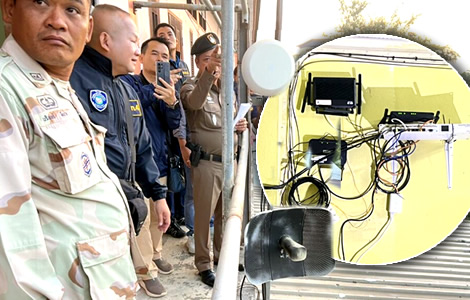
First, officers inspected a commercial building near the bridge. On the ground floor, they discovered network equipment installed on the walls. In total, three to four routers were found mounted in fixed positions.
Next, officers moved to the second floor of the same building. There, they found a point-to-point transmission antenna. Additionally, a signal dish was installed nearby. Importantly, both devices were aimed directly toward Myawaddy, Myanmar.
Following this discovery, authorities conducted further visual checks across the border. They observed a building in Myawaddy positioned opposite the Thai site. Notably, a similar antenna was visible on that building. The antenna appeared aligned to receive the transmitted signal.
Subsequently, officers inspected another commercial building in the same neighbourhood. This building was also located in Ban Rim Moei, Moo 2. However, the building was unoccupied at the time of inspection.
Routers and directional antennas found transmitting signals directly from Mae Sot into Myawaddy
Because the owner could not be contacted, authorities took additional procedural steps. They coordinated with the village headman for access. Witnesses were present to observe the process. Therefore, officers cut the lock and entered the building legally.
Inside, officers immediately found operational equipment. Two routers were still plugged in and powered on. At the same time, internet connectivity appeared active during the inspection.
Meanwhile, officers examined the condition of the interior walls. The walls showed extensive signs of equipment installation. Numerous nails were embedded across multiple surfaces.
In addition, nails were found securing power cables along the walls. The cable routing suggested a permanent setup. Furthermore, the installation showed evidence of repeated adjustments over time.
However, officers also noticed missing equipment. Several devices were no longer present in the room. Moreover, the remaining layout suggested recent removal.
Police forced entry into unoccupied building where active routers and signs of dismantling were found
Scattered marks and loose fittings indicated dismantling shortly before the raid. Consequently, investigators believed equipment had been removed recently. As a result, attention shifted to identifying responsible individuals.
Authorities then contacted the building’s tenant for questioning. In particular, investigators sought clarification on the internet installation. They also examined possible connections across the border.
During questioning, the tenant provided a statement. The tenant said an acquaintance had installed the internet connection. According to the tenant, the service was provided free of charge.
Additionally, the tenant stated that the signal was shared for personal use. Usage reportedly occurred at residences on the Thai side. At the same time, usage also occurred on the Myawaddy side of the border.
Tenant questioning revealed free shared internet use spanning both sides of the Thai-Myanmar border
Following the interviews, police documented all seized items. Each router and device was photographed and logged. Technical specifications were recorded for further analysis.
Moreover, the equipment will undergo forensic examination. Authorities aim to determine transmission capacity and usage patterns. Therefore, investigators will assess the full scope of the operation.
After the raid, Pol. Col. Anucha provided details to the media. He explained that the investigation began with the service provider’s report. Specifically, the reported internet usage was unusually high.
Based on that information, police sought judicial authorisation. A search warrant was issued by the court. Subsequently, officers executed the warrant at the identified locations.
Police confirmed that investigations are ongoing. The objective is to identify all individuals involved. Moreover, authorities stated that prosecutions will follow under applicable laws.
Meanwhile, enforcement operations continue in the Mae Sot area. Agencies remain in close coordination. Information sharing between departments is ongoing. Authorities also urged the public to report relevant information. Tips are considered critical to ongoing investigations. Therefore, officials encouraged cooperation through official channels.
Authorities report falling scam call volumes but maintain pressure on illegal networks across borders
In addition, authorities commented on broader enforcement results. They noted a decrease in calls linked to call centre gangs. However, monitoring continues despite the decline. Officials emphasised that operations will not slow. Crackdowns on illegal network use remain active. Overall, authorities confirmed continued enforcement to the fullest extent of the law.
Secrets of a sprawling international scam empire revealed on Thai Cambodian border in Surin province
Ung Ing finally gives the order. Thailand pulls the plug on scam centre electricity in Burma. Cut at 9 am
Chiang Mai professor slams Thai officials for failing to halt electricity sales to Burma’s online scam centres
Undoubtedly, Thai authorities have begun to weaken the kingdom’s links and assistance to the international scammer trade in Burma, Laos and Cambodia. However, in recent weeks, police have discovered similar placement of facilities to provide internet signals and telephone access to the country’s network for scammer gangs in Myanmar, Laos and Cambodia.
In turn, this has led the Royal Thai Police to warn landlords in border areas to beware suspicious renters who often pay in advance while installing facilities in the rented units, including in ceilings and on roofs.
The message is clear. The kingdom’s law enforcement agencies may have the scam centre gangs on the defensive. However, this is no time to let the guard down.
Join the Thai News forum, follow Thai Examiner on Facebook here
Receive all our stories as they come out on Telegram here
Follow Thai Examiner here
Further reading:
Secrets of a sprawling international scam empire revealed on Thai Cambodian border in Surin province
Cambodian scam compound murder boss ‘Mr. Ham’ nabbed by Thai and South Korean cops in Pattaya raid
Thailand and Cambodia face danger from ‘Dragon Head’ the Chinese mafia leader behind the scams
Cyber police and Money Laundering agency seek UK and US co-operation targeting Cambodian networks
United States, South Korea and United Kingdom act against Cambodian scam industry with Thai tie-ins
Ben Smith affair & allegations of links to Cambodian scam centres continues to rage in parliament
Defiant Rangsiman Rome warns he’s not just fighting a defamation case but for the future of Thailand
Ben Smith money fixer to the elite in Thailand lines up ฿100M defamation case against Rangsiman Rome