PM Anutin Charnvirakul has ordered a dramatic 90-day rethink of Thailand’s trillion-baht land bridge project as ministers, security chiefs and business leaders reassess costs, environmental risks and the efficacy of bypassing Singapore’s traditional shipping routes.
Thailand’s trillion-baht land bridge project has been thrust back into the political and economic spotlight after Prime Minister and Interior Minister Anutin Charnvirakul ordered an urgent 90-day review involving senior ministers, security agencies and business leaders amid geopolitical instability, investor uncertainty and mounting questions over outdated studies and environmental impacts. The sweeping reassessment will re-examine rail links, highways, pipelines and port infrastructure tied to Thailand’s plan to reshape regional freight routes and reduce the world’s reliance on transshipments through Singapore.
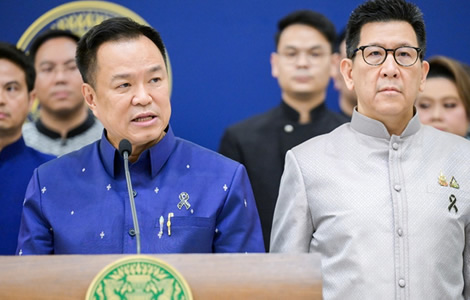
Prime Minister and Interior Minister Anutin Charnvirakul has ordered a sweeping new review of Thailand’s proposed land bridge megaproject, reopening debate over one of the country’s largest transport infrastructure plans.
On Tuesday, May 5, 2026, following a cabinet meeting, Mr Anutin signed Prime Minister’s Office Order No. 133/2026 establishing a committee to study ways to advance the project linking the Gulf of Thailand and the Andaman Sea.
The order stressed that the project must proceed “prudently and effectively.” Moreover, it directed officials to examine impacts in every dimension. The government also cited growing geopolitical instability. Consequently, the order warned that maritime transport systems now face rising uncertainty.
Cabinet order creates powerful panel to reassess Thailand’s land bridge amid global instability today
The order was issued under Section 11 (6) of the Administrative Procedure Act of 1991. Deputy Prime Minister and Finance Minister Ekniti Nitithanpraphas was appointed chairman of the committee. Meanwhile, Deputy Prime Minister Pakorn Nilapraphan was named vice-chairman.
The committee includes senior ministers across key economic and security portfolios. In addition, several permanent secretaries and state agency chiefs were added to the panel. The structure reflects the project’s scale and political sensitivity.
Committee members include the foreign affairs minister, transport minister, natural resources and environment minister, energy minister and industry minister. Furthermore, an assigned deputy interior minister will also participate. Permanent secretaries from the finance, transport, natural resources, energy, interior and industry ministries were appointed as members.
The Secretary-General of the Council of State also joined the committee. Likewise, the secretary-general of the Board of Investment was included. Security agencies were also drawn directly into the review process. Consequently, the secretary-general of the Maritime Security Command and the secretary-general of the National Security Council were appointed as members.
Senior ministers and security chiefs join new committee overseeing Thailand’s land bridge review
The government also expanded private sector participation in the review. The president of the Federation of Thai Industries was appointed to the committee. Meanwhile, the chairman of the Thai Chamber of Commerce will also participate.
Representatives from chambers of commerce in Gulf provinces and Andaman provinces were included as well. In addition, the order allows up to three public representatives from project areas to join discussions. Transportation and logistics experts were also added to the panel. Consequently, the committee combines government, business and local representation under one structure.
The National Economic and Social Development Council will act as the committee secretariat. Its secretary-general was appointed a member and secretary. Meanwhile, the director of the Office of Transport and Traffic Policy and Planning was named assistant secretary. A designated deputy secretary-general of the council will also serve as assistant secretary.
The order assigned the committee five major responsibilities. First, it must assess project feasibility and evaluate impacts across multiple dimensions. The findings will later be submitted to the prime minister and cabinet. Moreover, the committee must consider current geopolitical conditions when reviewing maritime transport trends and future logistics risks.
Business leaders and state planners join expanded national panel overseeing revised land bridge study
Second, the committee must gather opinions from all sectors. Consequently, stakeholder consultations were written directly into the order. Third, the panel can appoint subcommittees, working groups and specialists to support its operations.
Fourth, it can summon government agencies, experts and state officials to provide information during meetings. Fifth, it can carry out any additional duties assigned by the prime minister or cabinet.
The order also addressed committee expenses. Meeting allowances and operational costs will follow the Royal Decree on Meeting Allowances for Committee Members of 2004 and later amendments. Funding will come from the budget of the National Economic and Social Development Board.
Deputy Prime Minister and Transport Minister Pipat Ratchakitprakarn quickly defended the new review after the order became public. Mr Pipat rejected suggestions of internal disagreement over the project.
Committee ordered to assess impacts, gather opinions and report findings directly to cabinet plans
Instead, he described the decision as necessary under rapidly changing global conditions. He said the Finance Ministry-led review would ensure broader scrutiny of the entire development plan. Moreover, he confirmed that multiple ministries would now participate in the reassessment process. He stressed repeatedly that the final study would determine the project’s future direction.
Mr Pipat said the government would move immediately if the project proves economically worthwhile. However, he insisted that updated data must come first. He said earlier studies left gaps in several critical areas.
Consequently, the government decided to reopen the review process. According to Mr Pipat, previous assessments did not fully integrate rail, road and pipeline systems. In addition, the infrastructure behind the ports still requires deeper analysis. He argued that earlier studies focused too heavily on port construction alone. However, he said the broader logistics network remains equally important.
Transport minister backs fresh land bridge review as officials reopen studies and cost analysis again
The new review will also examine impacts on nearby communities and economic zones. Furthermore, officials will reassess concerns linked to land expropriation and local disruption. Mr Pipat said clear information must be available before final decisions are made.
He repeatedly stressed that cost-effectiveness would remain the central benchmark. After the 90-day review period, the working group will submit findings to the government. If approved, the Ministry of Transport will seek cabinet endorsement for the next phase.
Mr Pipat also questioned whether previous studies still reflected current realities. He said some information compiled by the Office of Transport and Traffic Policy and Planning was already two years old.
Consequently, officials believe major sections no longer match current conditions. He specifically cited changes in global logistics patterns and shipping behaviour. In addition, he pointed to evolving toll collection trends in the Strait of Malacca. Therefore, he said updated analysis had become unavoidable.
Environmental reviews and investor concerns return as officials revisit southern corridor strategy
Environmental impacts will also face renewed examination under the revised framework. Mr Pipat acknowledged that large infrastructure projects inevitably create environmental effects. However, he said the extent of those impacts still requires detailed study.
The Ministry of Natural Resources and Environment will lead environmental assessments alongside other agencies. Meanwhile, ministries linked to energy and industry will also participate directly in the process. Consequently, the government aims to broaden the review beyond the Transport Ministry’s perspective alone.
The land bridge project remains closely tied to the wider Southern Economic Corridor strategy. According to Mr Pipat, the corridor includes several southern provinces, including Chumphon, Ranong, Surat Thani and Nakhon Si Thammarat.
He said earlier discussions only covered selected sections of the corridor. Consequently, the new review aims to unify the entire project into one connected development framework.
Mr Pipat said the additional 90-day study period still fits within the government’s overall timetable. If the project advances smoothly, construction could begin around 2030, he said. Questions over foreign investor interest remain unresolved. However, Mr Pipat confirmed that the revised structure still includes major components such as oil pipelines, rail systems and highways.
Revised land bridge blueprint still targets regional freight links and reduced reliance on Singapore
Those links would connect with strategic economic zones, including the Eastern Economic Corridor and Laem Chabang Port. According to Mr Pipat, the system would strengthen freight movement between Asia and Europe. In addition, it would reduce reliance on transhipment routes through Singapore.
State agencies reach different conclusions on trillion baht Landbride plan. Poll shows public support
Questions about the viability of Srettha’s land bridge arise despite Monday’s euphoric briefings in Ranong
Mr Pipat said the land bridge concept has remained part of Thailand’s economic development framework since 2019. Nevertheless, the government ordered a fresh review to update data and address concerns from multiple sectors.
He said the reassessment would provide more comprehensive information across all areas. The government, he added, stands ready to proceed immediately if the project is judged economically worthwhile.
Join the Thai News forum, follow Thai Examiner on Facebook here
Receive all our stories as they come out on Telegram here
Follow Thai Examiner here
Further reading:
Commerce Minister meets US trade boss Jamieson Greer in Korea. Paul Chambers case still dogs talks