Thailand’s tourism slowdown deepens as arrivals fall 7%, spending slumps and Pattaya hotel occupancy crashes to 30%. Khao San Road businesses report collapsing revenues, rising costs and fears the rainy season could trigger a wider industry crisis.
Thailand’s tourism industry is coming under severe pressure as foreign arrivals fall, visitor spending weakens and operating costs surge across key destinations. In Pattaya, hotel occupancy has collapsed to as low as 30%, while bookings on Bangkok’s Khao San Road remain more than 20% below last year following Songkran. Meanwhile, tourism operators say travellers are spending far less after arrival as businesses battle rising fuel, food and packaging costs linked to global instability and soaring energy prices. Industry leaders are now demanding urgent government intervention, including airfare subsidies, major event support and free broadcasts of the 2026 FIFA World Cup, amid growing fears Thailand’s tourism slowdown could sharply worsen during the rainy season and the second half of the year.
Thailand’s tourism industry is slowing sharply as foreign arrivals and visitor spending weaken simultaneously. In April, foreign tourist numbers fell 7% from a year earlier. At the same time, spending by overseas visitors also declined.
Consequently, hotels, restaurants and entertainment businesses are reporting weaker revenues nationwide. Meanwhile, rising fuel and food prices are increasing pressure on already weakened operators.
Tourism businesses say the Middle East conflict has intensified energy costs and disrupted consumer confidence. Therefore, many smaller operators are struggling to cover daily operating expenses during the low season.
Pattaya hoteliers demand airfare subsidies as occupancy rates collapse during this weak low season
Across Pattaya and Chon Buri, tourism operators say conditions have deteriorated rapidly since Songkran. Last week, Pattaya City officials, the Association of Chonburi Tourism Federation and the eastern chapter of the Thai Hotels Association met Tourism and Sports Minister Surasak Phancharoenworakul.
During the meeting, operators urged the government to introduce urgent support measures. Most notably, they demanded airfare subsidies under the “Thai Teaw Thai Plus” programme.
Operators argued that domestic tourism is weakening because travel costs have risen sharply. During the pandemic, the programme subsidised 40% of domestic airfares. Therefore, tourism leaders want the scheme revived immediately.
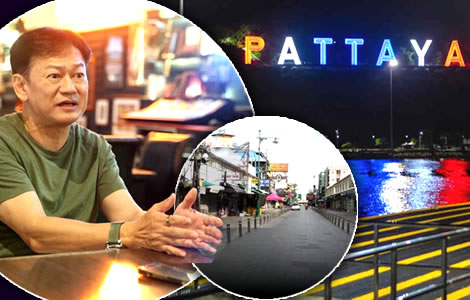
Thanet Supornsahasrungsi, president of the Association of Chonburi Tourism Federation, said Pattaya hotels normally maintain 60% to 70% occupancy during the low season. However, occupancy this month has collapsed to between 30% and 40%.
Work-from-home policies and cancellations deepen Pattaya hotel slump during severely weak months
According to Thanet, widespread work-from-home policies triggered severe disruption in the domestic meetings market. Public organisations postponed trips indefinitely. Meanwhile, private companies cancelled hotel conferences and seminars to reduce costs.
Consequently, hotels lost a major source of income during an already difficult season. Operators now depend heavily on foreign leisure travellers, especially visitors from China and India. Therefore, hotels are competing aggressively for a smaller pool of tourists by offering discounts and promotional packages.
Tourism operators also proposed changes to the government’s remote working arrangements. They suggested assigning the same work-from-home days across agencies. Consequently, employees could extend trips to tourism destinations by linking remote workdays with weekends.
Operators argued this would increase hotel stays and domestic spending. Meanwhile, Watcharapong Khunpluem, president of the eastern chapter of the Thai Hotels Association, warned conditions were worsening across coastal areas. He said hotel bookings in Bang Saen plunged 50% this month. The school holiday period is ending. However, meeting groups remain largely absent. Therefore, vacant rooms are increasing across the region.
Chon Buri operators push regional tourism strategy as Asian markets replace weaker European demand
Watcharapong also urged the government to allow provincial agencies to organise meetings within their own provinces or nearby areas. According to operators, many agencies have already allocated annual meeting budgets.
Nevertheless, those budgets are not reaching tourism businesses because events are being cancelled or postponed. Consequently, hotels are struggling to adjust operating costs while occupancy falls sharply. At the same time, electricity, transport and food expenses continue rising. Therefore, operators say profit margins are shrinking rapidly across the sector.
Tourism leaders also requested government support for international flight connections serving nearby Asian markets. These include China, Hong Kong, Taiwan, India, Malaysia and South Korea.
According to Thanet, short-haul markets now represent the industry’s strongest remaining opportunity. Meanwhile, long-haul tourism has slowed significantly because of expensive airfares, flight disruptions and weak seasonal demand. “Now we must prioritise domestic and short-haul markets,” Thanet said. Consequently, operators are shifting marketing strategies toward regional travellers as European demand weakens.
Khao San Road businesses report falling tourist numbers and sharply weaker visitor spending levels
In Bangkok, business owners on Khao San Road are reporting similar conditions. However, operators there say the downturn involves both weaker arrivals and lower spending per visitor. Sanga Ruangwattanagul, president of the Khao San Road Business Association, said businesses are now facing “two impacts” simultaneously.
First, hotel and accommodation bookings have fallen sharply since Songkran. Second, tourists are spending significantly less money after arriving in Thailand. According to Sanga, bookings on Khao San Road and nearby areas remain more than 20% lower than last year. Consequently, bars, restaurants and nightlife venues are seeing weaker daily revenues.
Sanga also blamed rising airline ticket prices for reducing long-haul tourism demand. Although direct flights to Thailand continue operating, many travellers are reconsidering expensive trips.
Meanwhile, the Tourism Authority of Thailand reduced its 2026 foreign arrival forecast from 35 million to 30 million visitors. However, Sanga believes even the revised target may prove difficult to achieve under current conditions. Therefore, operators are becoming increasingly concerned about the second and third quarters of the year.
Rising food and packaging costs squeeze Khao San Road businesses as tourist spending contracts further
At the same time, spending patterns among tourists have changed noticeably. According to Sanga, visitors who previously spent 1,000 baht per outing now spend only 700 to 800 baht. Consequently, businesses are handling smaller transactions while operating expenses continue climbing.
Fresh food prices have increased steadily. In some cases, seafood supplies have also declined. Meanwhile, restaurants are facing higher packaging costs because suppliers are increasing prices. Sanga said some large restaurants are now stockpiling plastic food and beverage packaging because they fear future shortages and further cost increases.
Overall, Sanga estimated that business costs have risen more than 10%. Nevertheless, many operators remain reluctant to increase menu prices. Businesses fear customers could reduce spending even further if prices rise aggressively.
Sanga said his own restaurant has not yet raised prices despite mounting pressure. However, some restaurants started introducing price increases in May. According to him, many increases are at least 10%. Consequently, operators are balancing rising costs against weakening customer demand.
Khao San Road operators warn that the rainy season slowdown will weaken tourism spending further
Sanga warned that conditions could deteriorate further during May and June as the rainy season approaches. Traditionally, tourism activity slows during that period. However, operators say this year’s weakness appears more severe than usual.
“In the past, we would still see some hotel bookings and tourists,” Sanga said. “This year the numbers are very low.” According to him, European arrivals have weakened sharply. Meanwhile, Chinese visitors are partly offsetting the decline. Nevertheless, businesses say overall traffic remains well below expectations.
“Tourist destinations like Khao San Road are facing a double blow,” Sanga said. “A decline in tourists and a contraction in purchasing power, while costs are rising.” He added that existing support programmes are providing only partial relief.
Even with the “Thai Helps Thai Plus” campaign, businesses say assistance remains limited compared with rising operating costs. Meanwhile, inflation and weaker household income levels are affecting consumer behaviour across the economy. Consequently, customers are spending more cautiously on entertainment and dining.
Sanga pushes concerts and free World Cup broadcasts to revive Thailand’s weakening tourism sector
Sanga also urged the government to support Thailand as a venue for international concerts and festivals. According to him, major events could stimulate spending across hotels, restaurants and nightlife businesses.
He argued that government support packages or revolving funds could encourage private investment in tourism events. At the same time, Sanga called for transparency regarding the proposed 400 billion baht government loan programme.
He also expressed support for alternative energy projects, including solar power systems and electric vehicle programmes aimed at reducing long-term energy costs.
However, Sanga placed particular emphasis on the 2026 FIFA World Cup. He said free broadcasts of tournament matches could significantly increase nighttime spending across Thailand’s hospitality sector. Therefore, he called for urgent cooperation between government agencies, broadcasters and private sponsors.
Businesses back World Cup broadcasts and Halloween campaign to revive spending on Khao San Road
According to Sanga, many companies would likely support sponsorship arrangements if the government coordinated the project effectively. “The upcoming World Cup is a significant factor in encouraging people to go out, have fun and spend money,” he said. He estimated the broadcasts could increase nighttime spending by between 30% and 50%.
Wave of badly behaved foreign tourists hits Thailand’s already crisis hit industry with numbers down 7%
57 countries plus China to still be afforded visa on arrival but only for 30 days under new visa policy
Meanwhile, Khao San Road operators are preparing additional tourism campaigns ahead of the high season. Sanga said the area will host a large-scale Halloween event later this year with a budget exceeding 5 million baht. Organisers plan to hire a Halloween design team from New York to transform the street into a themed tourist attraction.
In addition, multiple entertainment activities are planned throughout the event. Most notably, organisers will offer a 100,000 baht prize for the best costume competition winner. Consequently, businesses hope the event will attract foreign visitors and increase spending during what is turning into a particularly difficult year for Thailand’s tourism economy.
Join the Thai News forum, follow Thai Examiner on Facebook here
Receive all our stories as they come out on Telegram here
Follow Thai Examiner here
Further reading:
Irishman’s madness on a Phuket highway sparks a viral video and online outrage over Free Visa access
New Zealand Day brothers have landed back home in their own country after 4 months in detention
Russian mafia gang extort young Russian couple out of $50k at a local coffee shop on Ko Samui