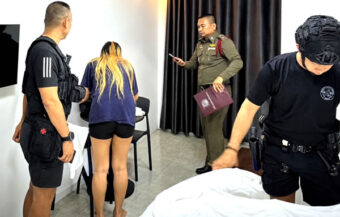
Songkran erupts in Bangkok with huge water fights as millions travel nationwide, roads clog fast, and police crack down hard after 2,617 drunk driving arrests. Accidents and deaths again loom over Thailand’s most dangerous holiday period.
Songkran surged into full swing in Thailand on Saturday with a music festival and beach party in downtown Bangkok, featuring water pistol fights in a controlled atmosphere. Meanwhile, the Royal Thai Police stepped up enforcement of a plan to cut road deaths during the seven-day danger period from April 10 to 16. On Friday, 2,617 people were arrested for drunk driving, while 20 died on the kingdom’s roads. Notably, this was well below the 35–50 daily deaths seen in previous years, a key test for police. Last year, 253 died during the period, an 11.4% drop from the year before.
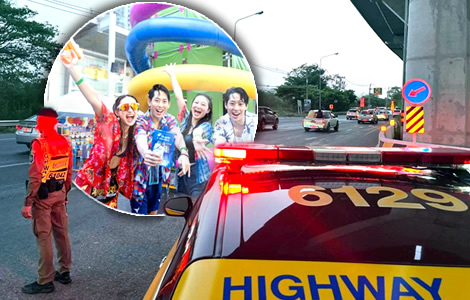
As Songkran begins across Thailand, millions are travelling to their home provinces. Meanwhile, others are departing for holidays nationwide. As a result, traffic volumes are rising sharply on major routes.
At the same time, attention centres on water celebrations in Bangkok and other urban centres. However, after that, focus quickly shifts to the country’s roads. Notably, these roads record high accident rates during the holiday period. Typically, daily fatalities range between 35 and 50 nationwide. Therefore, safety officials and police classify the seven-day period as high risk.
On Saturday, celebrations broke out at CentralWorld in the Ratchaprasong district of downtown Bangkok. Large crowds gathered early in the day. Despite the hot weather, attendance remained high throughout. Specifically, the venue hosted “Pepsi Presents Thai Lizm 2026.” In short, a music festival and beach party extravaganza in Thailand’s capital.
CentralWorld Songkran festival draws crowds with water fights, music shows and large scale attractions
As a result, the complex transformed into a large entertainment zone. Water play areas operate across the site. Meanwhile, a giant slide installation drew steady crowds. Visitors used it continuously during the day. Consequently, it became a central attraction for festival-goers.
On the main stage, a T-pop music festival took place. Popular artists performed live sets throughout the day. As expected, large audiences gathered near the stage. In addition, the performances sustained a high-energy atmosphere.
Crowds remained dense in central Bangkok. Movement across the venue continued without interruption. However, traditional elements were also present. Visitors poured water over Buddha images in designated areas. At the same time, cultural performances were staged nearby. Therefore, the event combined modern entertainment with traditional practices.
Elsewhere, a food market operated throughout the venue. Vendors offered a wide selection of Thai street food and beverages. Both locals and international tourists used the facilities. Organisers confirmed that the site is accessible via public transport. In addition, parking capacity exceeds 6,000 spaces.
Significantly, crowd control systems were deployed across the venue. Visible safety measures were introduced to manage large numbers. As a result, operations continued without major disruption during the first day.
Police deploy nationwide traffic controls as heavy travel triggers congestion on major routes
Meanwhile, authorities across the country focused on road management. The Royal Thai Police coordinated traffic operations nationwide. Officers were deployed on highways and key urban routes.
Friday, April 10, saw the holiday period officially begin. Immediately, traffic volumes increased on major roads. Many travellers departed Bangkok for provincial destinations. As a result, congestion formed on several key highways. Bottlenecks appeared at major junctions and access points.
Therefore, police implemented active traffic control measures. Officers were ordered to accelerate traffic flow. They targeted congested routes and high-volume corridors. In response, reversible lanes were opened where necessary. Additionally, these measures were adjusted throughout the day. Traffic conditions dictated operational changes. At the same time, personnel were mobilised nationwide. Officers provided roadside assistance and traffic direction. Consequently, authorities aimed to reduce travel times and maintain a steady flow.
Furthermore, law enforcement intensified traffic checks. Officers targeted high-risk behaviours linked to accidents. These included drunk driving, speeding, and failure to use safety equipment.
Equally, helmet and seatbelt compliance were strictly enforced. Authorities identified these violations as major contributors to accidents. Therefore, enforcement focused heavily on these areas. In Bangkok, reduced congestion led some drivers to increase speed. As a result, speeding became a growing concern.
Drunk driving arrests and traffic offences surge as enforcement targets high risk behaviour nationwide
On April 10, police recorded 2,617 drunk driving cases nationwide. Among them, 26 were repeat offenders. Consequently, these individuals face higher penalties under the law. In total, 67,803 offences were recorded across ten categories.
Notably, failure to wear helmets led with 15,994 cases. Speeding followed with 13,450 cases. In addition, 3,809 cases involved failure to wear seatbelts. These figures reflect widespread non-compliance during the holiday period.
Officials linked these patterns directly to accident risks. Therefore, enforcement remains a central priority. The Traffic Management Centre issued clear operational directives. Officers were instructed to enforce laws while maintaining traffic flow.
This dual approach remains in place nationwide. Police General Samran Nualma confirmed the strategy. He serves as Deputy Commissioner-General of the Royal Thai Police. He also directs the Road Accident Prevention and Reduction Centre during Songkran 2026.
Senior police outline coordination strategy and public guidance as travel risks rise during festival period
Additionally, Police General Somprasong Yenthuam outlined coordination efforts. He serves as Deputy Director of the Traffic Management Centre. Nationwide integration between units is ongoing. Pol. Lt. Gen. Nithithorn Chintakanon also addressed the situation. He leads the Traffic Police Education Division. Furthermore, he heads a working group on traffic police image improvement. He stated that drivers should plan journeys in advance. Vehicle checks were also advised before travel.
Moreover, drivers were instructed to comply strictly with traffic laws. They were also told to drive carefully and consider other road users. These measures aim to reduce incidents during the holiday. Hotlines remain active throughout the period.
The Traffic Police Division can be reached at 1197. Meanwhile, the Highway Police hotline operates at 1193. In addition, Royal Thai Police numbers 191 and 1599 are available. All services operate 24 hours a day.
Looking at recent data, accident figures remain high during Songkran. In 2025, 253 people died over the seven-day period. Additionally, 1,495 people were injured. However, this marked a decline from 2024. That year recorded 287 deaths. Therefore, fatalities fell by 11.4 per cent year-on-year. Authorities described this as a measurable reduction.
Motorcycle accidents dominate Songkran road deaths as government pledges stricter enforcement
Motorcycles remained the dominant factor in accidents. In 2025, they accounted for 85 per cent of incidents. This rose from 80 per cent in 2024.
As a result, motorcycles continue to dominate accident statistics. Officials continue to monitor this trend closely. Nonetheless, authorities state that progress is being made. Enforcement measures are expanding nationwide.
Songkran underway all over Thailand but particularly in Bangkok, for water play and a PM in the sky
Thailand celebrates its New Year on Songkran as two minor earthquakes strike in Chiang Mai and Krabi
Pattaya’s Songkran Mayhem must be toned down or kept in check warn the city’s police as tempers flare
Meanwhile, the government has outlined its position clearly. Prime Minister Anutin Charnvirakul has pledged strict enforcement of road laws. Furthermore, senior officials have warned that no leniency will be given to offenders.
Drivers who violate safety laws will face penalties. Repeat violations will result in stronger legal action. As celebrations continue, the government and Royal Thai Police appear determined to keep their word.
Join the Thai News forum, follow Thai Examiner on Facebook here
Receive all our stories as they come out on Telegram here
Follow Thai Examiner here
Further reading:
Pattaya police charge 33-year-old doorman with assault causing harm after punching angry UK tourist
End of the road proposed for Thailand’s ‘Happy go-Lucky’ Economy in Paetongtarn’s Policy Statement
Revenue Department preparing legislation as new Expat tax regime may link visas and tax returns
New tax era in Thailand begins as Revenue now shares data with 138 countries within the OECD
Calls for clarification of new Tax regime which appears to target expat foreign income sources