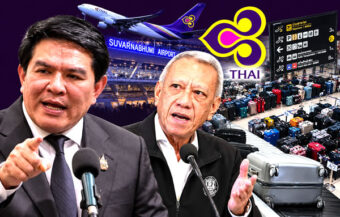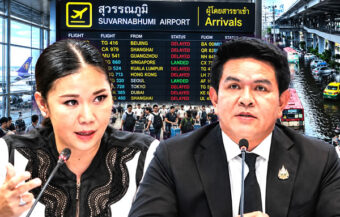
A plan to charge foreign tourists up to ฿500 has hit fresh turbulence after airlines refused to collect the levy, reigniting a years-long dispute that has repeatedly derailed a key tourism reform.
Thailand’s long-promised foreign tourism levy has run into another major obstacle after airlines again rejected government plans to collect a proposed fee of up to ฿500 through ticket sales, warning the scheme is unworkable and urging ministers to use Thailand’s Digital Arrival Card instead. The latest clash revives a dispute that has delayed the policy for years, strained relations between Bangkok and the aviation industry, complicated efforts to attract new international routes since the pandemic and left successive governments unable to introduce a levy designed to fund tourist insurance while recovering billions of baht in unpaid medical costs.
Thailand’s long-delayed tourism levy has hit another obstacle after airlines again rejected government plans to collect the fee through airline ticketing systems.
Instead, the aviation industry has urged ministers to use the Thailand Digital Arrival Card (TDAC), arguing it offers the only practical collection method. The renewed disagreement revives a dispute that has delayed the policy for years and repeatedly frustrated successive governments.
Last month, the Ministry of Tourism and Sports asked airlines to collect the levy on the government’s behalf when passengers purchased tickets to Thailand. The proposal aims to launch a scheme first formally announced in 2020, but discussed for much longer.
Government seeks higher tourism levy while airlines reject plans to collect charges through ticket sales
Initially, officials proposed a charge of at least ฿300 per foreign visitor. More recently, Tourism and Sports Minister Surasak Phancharoenworakul suggested the levy could rise to as much as ฿500. The final figure will depend largely on insurance costs and projected medical treatment expenses.
However, the proposal immediately exposed legal and operational difficulties. Under the National Tourism Policy Act, only foreign visitors are required to pay the levy. Thai citizens are exempt.
As a result, the ministry suggested charging every passenger before refunding Thai nationals afterwards. It also offered to reimburse airlines for the administrative costs. Even so, aviation organisations say the proposal remains impractical.
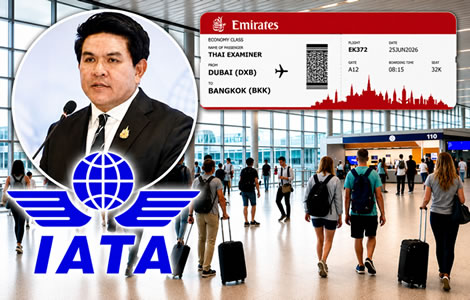
Sheldon Hee, regional vice-president for Asia-Pacific at the International Air Transport Association (IATA), said airline reservation systems cannot identify passengers liable for the charge.
Typically, airlines require only a passenger’s name and destination when issuing tickets. Nationality, passport details and residential addresses are usually collected later. Therefore, carriers cannot reliably distinguish between Thai citizens and foreign visitors during the booking process.
Airline booking systems cannot identify liable passengers or separate foreign visitors from Thai citizens
Mr Hee also warned that the proposal would create operational problems at airports. He questioned what would happen if an airline discovered a passenger had not paid the levy. Airlines have no established process to collect government charges at check-in.
Likewise, airport counters are not designed to process missed tax payments before departure. Consequently, attempting to resolve outstanding levies at airports could slow passenger processing and disrupt normal operations.
Instead, IATA says the Thailand Digital Arrival Card provides a ready-made solution. Foreign visitors are already required to complete the TDAC before travelling to Thailand.
Therefore, incorporating the levy into that digital process would remove many of the administrative problems facing airlines. Notably, the Immigration Bureau already verifies passenger identities before entry. That makes the system better suited to determining who must pay the charge.
The Airlines Association of Thailand (AAT) has reached the same conclusion. Following recent discussions with ministry officials, the association said aviation stakeholders overwhelmingly support collection through the TDAC.
Aviation industry backs digital arrival card as the simplest and most practical way to collect the levy
According to the AAT, even Thai airlines operate different reservation and back-office systems. Introducing a single collection process would therefore be difficult. The challenge becomes even greater when more than 100 international airlines serving Thailand are included.
Separately, the association stressed that airlines operate independently of the government. By contrast, the TDAC is administered directly by the Immigration Bureau. Aviation executives, therefore, argue immigration officials, not airlines, should collect the levy because they already control passenger entry procedures and government travel records.
The latest disagreement is only the newest chapter in one of Thailand’s longest-running tourism policy disputes. For more than a decade, successive governments have promised to introduce a tourism levy on foreign visitors.
Yet every administration has failed to implement it. Repeated announcements have been followed by revised launch dates and fresh delays. Throughout that period, the biggest obstacle has never been the principle of the levy. Instead, governments have repeatedly failed to find a practical and internationally acceptable collection system.
Successive governments failed to launch tourism levy after years of promises and repeated changes
Officials have consistently argued the levy would provide automatic insurance cover for foreign visitors. The remaining revenue would fund improvements to tourist attractions, infrastructure and visitor safety. The proposal is also intended to reduce the financial burden created by uninsured foreign visitors requiring emergency medical treatment.
Government studies estimate that unpaid medical bills left by foreign visitors cost Thai hospitals around ฿2.5 billion each year.
Accordingly, ministers have repeatedly argued the levy would create a dedicated funding source for insurance while easing pressure on public finances. However, the exact amount has never been finalised because insurance costs continue to be assessed.
The current dispute echoes an earlier confrontation with the aviation industry. Before the Covid-19 pandemic, the government also attempted to collect the levy through airline ticket prices. IATA strongly opposed the proposal.
Airline opposition to collecting tourism levy stretches back to disputes before the Covid-19 pandemic
Airline executives argued then, as they do now, that carriers should not become tax collectors for governments. They also warned that integrating a Thailand-specific charge into global reservation systems would increase costs and create unnecessary technical complexity.
In response, relations between Bangkok and the aviation sector became increasingly strained. Airline executives warned the proposal risked making Thailand less competitive than neighbouring destinations. They also argued governments should simplify international travel rather than impose additional administrative obligations on carriers.
Following the pandemic, the disagreement became even more significant. Airlines were rebuilding international networks while deciding which destinations would regain capacity first.
At the same time, countries across Asia were competing aggressively for new routes. Industry representatives believed the continuing dispute created unnecessary friction when Thailand needed to strengthen relations with international carriers. Some aviation observers also warned the proposal risked weakening Bangkok’s ability to attract additional services during the recovery.
Alternative payment systems also stalled despite efforts to remove airlines from the tourism levy process
Faced with sustained opposition, the government abandoned plans to collect the levy through airline tickets. Officials instead examined alternative collection methods. Among the options were self-service payment kiosks at airports.
Online payment through Thailand’s planned electronic travel authorisation and digital entry systems was also considered. As part of this, removing airlines from the collection process was intended to satisfy industry concerns while ensuring visitors paid before arrival.
Tourism levy now planned for the 3rd quarter of 2026 with insurance while World Cup deal remains elusive
Higher foreign tourism levy now being proposed by minister to allow for enhanced visitor insurance cover
Those alternatives, however, never reached implementation. Delays to Thailand’s wider immigration technology projects postponed the scheme once again. As a result, the tourism levy remained on hold despite repeated assurances that its introduction was imminent.
Now the proposal has returned to the government’s agenda. Yet the central obstacle remains unchanged. Airlines have once again rejected any proposal requiring carriers to collect the levy or modify international ticketing systems.
Instead, the industry continues to support collection through the Thailand Digital Arrival Card. After years of debate, revised plans and repeated political commitments, Thailand still lacks a practical mechanism for implementing one of its most persistent tourism policies.
Join the Thai News forum, follow Thai Examiner on Facebook here
Receive all our stories as they come out on Telegram here
Follow Thai Examiner here
Further reading:
Irishman’s madness on a Phuket highway sparks a viral video and online outrage over Free Visa access
New Zealand Day brothers have landed back home in their own country after 4 months in detention