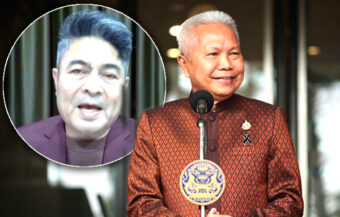
Thai police ready to issue arrest warrants for 10 politicians as scam probes widen. Cambodia deports tycoon Chen Zhi to China in chains. US, UK and UN scrutiny mounts over billion-dollar cyber scam networks spread across Southeast Asia, but centred on Cambodia.
Following last year’s bombshell revelations into Chinese mafia-controlled scam compounds in Cambodia and their links to a powerful local conglomerate, one of Phnom Penh’s leading tycoons was arrested on January 6 and deported to China in chains. Days later, Cambodian authorities moved to liquidate a licenced bank tied to his sprawling business empire. The actions come as law enforcement agencies in the United States, South Korea, Cambodia, and Thailand intensify investigations into the vast scam compound industry and illegal online fraud. United Nations reports have repeatedly identified Cambodia as the centre of the industry. However, investigators believe the scale of the criminality points to a powerful Chinese mafia network operating behind the scenes.

Thai and Cambodian authorities are intensifying coordinated actions against transnational cybercrime networks operating across Southeast Asia. In Thailand, the Royal Thai Police are reportedly preparing arrest warrants for 10 Thai politicians.
Importantly, several are former members of the last parliament. These reported warrants stem from investigations into scam centres and associated money laundering networks.
Earlier disclosures, particularly in parliament and US Federal Bureau of Investigation (FBI) actions, triggered the current Thai investigations. However, the fallout has not receded. Instead, it has widened across multiple agencies. As a result, a high-level committee remains active. That committee is chaired by Prime Minister Anutin Charnvirakul. It continues to oversee coordination among law enforcement, financial regulators, and security bodies. Meanwhile, investigators are examining political, financial and cross-border links tied to scam operations.
Thailand elevates scam investigations as political exposure grows and financial risks widen
At the same time, Thai authorities are assessing broader risks to financial stability. Specifically, investigators are probing exposure to illicit capital flows. Consequently, the issue has moved beyond routine policing. It is now treated as a national security concern. Moreover, Thai officials have linked scam networks to organised crime structures operating regionally.
Against this backdrop, Cambodia made a decisive move on January 6. On that day, Cambodian authorities arrested Chen Zhi, once among the country’s most powerful tycoons.
Shortly afterwards, he was deported to China in chains. The move followed months of joint investigations with Chinese officials.
Chen Zhi, aged 38, was born in China. Later, he became a Cambodian citizen after renouncing Chinese nationality in 2014. However, Cambodian authorities confirmed his citizenship was revoked last December. According to the Interior Ministry, the revocation complied with Cambodian nationality law. Subsequently, Chen was expelled following a formal request from Beijing.
Cambodia arrests and deports tycoon Chen Zhi after months of coordinated investigation with China
The Cambodian Interior Ministry stated that the arrest fell within the remit of its cooperation with China to combat transnational crime. Moreover, it confirmed that months of joint investigative work preceded the operation. Interior Ministry spokesman Tok Sokhak said the arrest occurred on January 6. However, officials declined to disclose detailed charges.
Soon after, China’s foreign ministry responded publicly. It said cracking down on online gambling and telecom fraud was a shared international responsibility. Additionally, it said China had actively cooperated with Cambodia and other countries.
According to Beijing, such cooperation had produced notable results. However, Chinese officials did not comment on Chen’s specific legal case.
Cambodia has faced mounting international pressure over scam operations. In recent years, it has become a major hub for cyber fraud. Consequently, scrutiny from Western governments has intensified. Financial losses linked to Cambodia-based scams have also surged.
Western losses and indictments intensify scrutiny as Cambodia is named a global hub of scams
According to US estimates, Americans lost at least $10 billion in 2024 to scam operators. Notably, many of those operators were based in Southeast Asia. Among those locations, Cambodia features prominently. As a result, enforcement expectations increased sharply.
Earlier, in October, the United States and the United Kingdom indicted Prince Group. The Cambodian conglomerate was chaired by Chen Zhi. The indictments accused the group of running industrial-scale scam centres across Cambodia. According to US filings, these centres operated inside guarded, prison-like compounds.
Moreover, the indictments alleged that workers were lured with false job offers. Instead, they were confined and forced to conduct cyber romance and investment scams. Cryptocurrency fraud featured heavily. Additionally, authorities alleged systematic money laundering.
US investigators said criminal proceeds flowed through Prince Group’s legitimate businesses. Real estate and financial services were cited. Prince Group, founded in 2015, expanded rapidly under Chen’s leadership. Its operations spanned property development, finance and consumer services.
Banking exposure and elite political ties deepen scrutiny of Prince Group’s role in scam operations
The Prince Group, for instance, even owned Prince Bank, a licensed financial institution in the kingdom. On Thursday, however, Cambodian authorities announced moves to liquidate the financial institution. It was banned from accepting new business or deposits.
Meanwhile, Chen is known to have cultivated deep ties with Cambodia’s political elite. He served as an adviser to former Prime Minister Hun Sen. He also advised other senior officials. Later, he received the honorific title “Neak Oknha.” The title required a $500,000 donation to the government. It signalled elite political standing.
However, Cambodian media later reported a reversal. King Norodom Sihamoni reportedly revoked Chen’s decorations. The “Oknha” title was also withdrawn. These steps followed Chen’s arrest and deportation.
According to US authorities, Prince Group later concealed a major criminal expansion. Investigators allege it became one of Asia’s largest transnational criminal organisations. Specifically, filings claim the group controlled illicit financial flows worth billions of dollars. Moreover, it allegedly operated forced-labour scam compounds nationwide.
Trafficking, pig butchering scams and silence from suspects trigger international response
Investigators also described “pig butchering” scams. In these schemes, fraudsters groom victims over long periods. Eventually, they extract large investments. Researchers say thousands were trafficked into scam centres across Cambodia, Myanmar and Laos. Victims were promised legitimate jobs. Instead, they faced coercion and confinement.
Despite the allegations, Prince Group did not respond to requests for comment. Likewise, Chen’s legal representatives remained silent. Meanwhile, uncertainty surrounds Chen’s extradition outcome. It remains unclear how US and UK criminal charges will proceed. No timetable has been announced.
Some analysts said Cambodia’s decision reflected diplomatic calculations. They argued that deportation to China was simpler than extradition to Western courts. Cambodia remains a long-standing ally of Beijing. Jacob Sims of Harvard University’s Asia Centre said Beijing likely opposed Western trials. He added that Chen is likely to face prosecution in China.
At the same time, Cambodia faces competing pressures. China is its largest investor. Conversely, the United States is its biggest export market. Additionally, Cambodia faced the threat of higher US tariffs and a still unresolved border conflict with Thailand. These pressures undoubtedly influenced enforcement decisions.
For instance, it is quite possible that if Mr. Chen Zhi were handed over to US authorities, he may have offered evidence in some sort of plea deal. In turn, this may have implicated the Cambodian leadership, which is widely believed to have been complicit in the scamming industry.
Cambodia defends extradition as tensions with Thailand rise over border security and scam suppression
Against this backdrop, Cambodian officials defended the extradition. They said it proved domestic enforcement capacity. Cambodian media echoed that position. The Khmer Times cited experts praising the arrest. The outlet said the case showed Cambodia could tackle online fraud independently.
Cambodian authorities also confirmed additional deportations. Two Chinese nationals, Xu Jiliang and Shao Jihui, were expelled alongside Chen. Officials said all three were linked to transnational crime investigations. However, no further details were released.
Meanwhile, tensions with Thailand remain visible. Thai officials have linked border security operations to scam suppression. Military statements cited call centres near the border. These facilities are often housed in casino-style buildings. Money laundering and human trafficking were also cited.
Cambodian commentators rejected Thai claims. They accused Thailand of politicising cybercrime. Cheong Kimlong of the Asian Vision Institute said Cambodia strictly enforces law and sovereignty. He accused Thailand of using cybercrime allegations to justify military actions.
Chen case exposes alleged 14k triad leadership as regional probes widen across Southeast Asia
Similarly, Kin Phia of the Cambodian Institute of International Relations highlighted cooperation. He said the Chen case showed effective joint enforcement. He added that targeting masterminds was essential. However, he rejected claims of external leadership in Cambodia’s crackdown.
Beyond Cambodia, the Chen case exposed wider criminal structures. US investigations allege links to Chinese organised crime. The 14K triad was identified as a central actor. The group is led by Wan Kuok-koi, widely known as “Dragon Head.”
According to intelligence reports, 14K expanded into Southeast Asia after 2013. Pressure from Beijing drove the relocation. Cambodia became a major base. US authorities believe Chen was a senior operator, not the ultimate leader. Consequently, regional investigations remain ongoing.
United Nations warnings and regional cases underline the scale of casino-linked scam compounds
At the same time, there is doubt and unease about the operations of these illicit scam compounds, which are often linked with casinos. These activities have emerged in Myanmar and Laos, as well as Cambodia. Undoubtedly, they are connected with massive Chinese investment.
In 2025, the United Nations warned that the scam compound industry was centred on Cambodia and that it was facilitated by power networks linked to the Cambodian regime.
Pressure is building on Thai officials as the Southeast Asian scam centre issue rises in Washington DC
High powered, secretive meeting chaired by PM agrees robust action against Cambodian networks
Thailand and Cambodia face danger from ‘Dragon Head’ the Chinese mafia leader behind the scams
United States, South Korea and United Kingdom act against Cambodian scam industry with Thai tie-ins
There is mounting intelligence that the phenomenon seen in Southeast Asian countries is the work of Chinese mafia networks.
For instance, She Zhijiang was a Chinese mafia kingpin who was extradited from Bangkok to China on November 10 last year. The figure was a key player in both Myanmar and Cambodia. At one point, his lawyer in Bangkok claimed he was encouraged by Chinese authorities in his schemes.
Join the Thai News forum, follow Thai Examiner on Facebook here
Receive all our stories as they come out on Telegram here
Follow Thai Examiner here
Further reading:
Thailand and Cambodia face danger from ‘Dragon Head’ the Chinese mafia leader behind the scams
Cyber police and Money Laundering agency seek UK and US co-operation targeting Cambodian networks
United States, South Korea and United Kingdom act against Cambodian scam industry with Thai tie-ins
Ben Smith affair & allegations of links to Cambodian scam centres continues to rage in parliament
Defiant Rangsiman Rome warns he’s not just fighting a defamation case but for the future of Thailand
Ben Smith money fixer to the elite in Thailand lines up ฿100M defamation case against Rangsiman Rome