People’s Party launches its proposed “People’s Government,” pledging a 12-month overhaul of the Royal Thai Police, justice reform and anti-corruption measures as new NIDA polls show the party leading in a tightening race ahead of Thailand’s February 8 election.
In a tightening general election race, the People’s Party on Sunday unveiled plans for a “People’s Government,” centered on reforming the justice system and the Royal Thai Police. The move came as fresh National Institute of Development Administration (NIDA) polling showed the party leading, while the ruling Bhumjaithai Party continues to gain ground. The Pheu Thai Party and the Democrat Party are also rising compared with earlier polls. With constituency-level dynamics set to determine final seat counts, the next government will hinge on post-election bargaining to form a coalition after February 8.

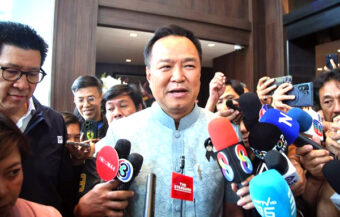
The People’s Party on Sunday formally presented its policy platforms and proposed governing team to the public. The event marked the launch of what the party calls a “People’s Government.” Notably, the presentation centered on police reform, justice, and state administration. At the same time, the party linked its proposals to current election polling data.
The event took place on January 11, 2026, at Samyan Mitrtown in Bangkok. There, senior party figures outlined policies across security, justice, the economy, foreign affairs, and governance. Meanwhile, the party introduced individuals expected to assume senior roles if it forms the next government.
Most prominently, the People’s Party pledged to reform the Royal Thai Police within 12 months of taking office. In particular, the party committed to suppressing corruption and restructuring the police nationwide. According to the party, this reform would be comprehensive and time-bound.
People’s Party launches proposed government, linking police reform and justice overhaul in manifesto
Pijarn Chaowapatanawong, the proposed Deputy Prime Minister for Democracy and Security, delivered the core policy address. First, he focused on justice access in Thai society. He stated that justice has become inaccessible to many citizens. Specifically, he said wealth determines legal outcomes.
According to Pijarn, studies show that defending a basic criminal case can cost up to 120,000 baht. At the same time, he said more than half of Thais earn less than 4,000 baht per month. As a result, many defendants cannot afford bail. Consequently, prisons risk becoming places for the poor.
By contrast, he said influential individuals face different outcomes. In those cases, court orders can be withdrawn. Moreover, he said, interference has reached the judiciary itself. He cited cases where judges committed suicide. Additionally, he said illicit capital has turned parts of the prison system into privileged spaces.
Turning to law enforcement, Pijarn said trust in the police has collapsed. In particular, he cited corruption scandals within the force. These included the “black bag” case and online gambling investigations. Notably, those investigations implicated senior police figures, including a former police chief.
Pijarn outlines justice access gap, prison inequality and senior police corruption scandals
According to Pijarn, these scandals reflect systemic failure. He stressed that the issue is not individual misconduct. Instead, he said the structure enables abuse of power. As a result, those in authority act without fear of consequences.
In response, the People’s Party proposes dismantling the existing police structure. Then, it plans to rebuild the institution through three stages. These stages are suppression, restructuring, and reform. Ultimately, the stated goal is a police force that serves the public sustainably.
First, the suppression stage targets internal discipline and appointments. Pijarn said transfers and promotions must become transparent. Accordingly, opaque practices would end. He said buying and selling police positions would be eliminated entirely.
Specifically, this ban would apply to all ranks. This includes inspectors and superintendents. Furthermore, he said politicians and military officers would no longer receive police ranks. Under a government led by Nattapong Ruangpanyawut, such practices would stop.
Plan targets Police appointments, promotions and rank trading under a proposed People’s Government
Next, the party plans to introduce a 360-degree evaluation system. According to Pijarn, the system would be scientific and transparent. It would assess seniority, examinations, and physical tests. In addition, it would assess conduct and past performance.
Moreover, evaluations would include feedback from superiors, subordinates, colleagues, and the public. Consequently, officers would no longer rely on lobbying. Instead, advancement would depend on measurable performance.
Second, the restructuring stage targets cronyism. To address this, the party plans to establish an independent oversight committee. At the same time, it would create a digital complaint platform. Citizens would monitor processes in real time.
According to Pijarn, this approach would reduce fear within the system. Furthermore, it would discourage deference to power. He said accountability would become routine rather than exceptional.
Oversight bodies and public monitoring proposed to dismantle cronyism within Police administration
Third, the reform stage addresses welfare and responsibilities. Pijarn said officer morale depends on fair welfare systems. Therefore, budgets would be reallocated. Funds currently used for ceremonial travel and study tours would be reviewed.
If unnecessary, those expenses would be cut. Instead, funds would support lower-ranking officers. For example, case-handling allowances would be adjusted. Pijarn noted these allowances have not changed for 34 years.
Additionally, the party would review housing and rental reimbursements. Medical expense coverage would expand beyond Bangkok. Importantly, Pijarn said many officers still buy their own equipment. He said the party would address this directly.
At the same time, the party plans to transfer responsibilities away from the police. These include consumer protection and forestry enforcement. According to Pijarn, other agencies have better expertise. Consequently, police would focus on crime prevention and suppression.
Welfare reform, budget reallocation and transfer of non-core duties form central pillar of plan
Meanwhile, forensic and evidence analysis would move outside police control. This change aims to balance investigative processes. According to the party, this would strengthen credibility.
Structural reform would also reshape training institutions. The Sam Phran Police Academy would be upgraded to university status. It would gain academic independence and its own legislation. Pijarn said military-style culture would end.
Instead, training would emphasise law, investigation and rule of law principles. Officers would become specialists rather than generalists. According to Pijarn, this shift is essential for long-term reform.
Regional policing structures would also change. Budget authority would be decentralised to provinces. Provincial police would be linked to elected governors. Furthermore, provincial committees with public participation would oversee operations.
Decentralised policing and university-level training proposed to reshape force and oversight nationwide
Promotion would depend on performance and local needs. Nepotism would no longer determine advancement. Meanwhile, the central police force would focus on specialised cases. Auditing divisions would operate independently to ensure scrutiny.
These policy announcements coincided with new election polling. On January 11, the National Institute of Development Administration released its first-round election survey. The poll was conducted from January 5 to 8.
The survey questioned 2,500 respondents nationwide. All respondents were aged 18 or older. Sampling used multi-stage probability methods. Interviews were conducted by telephone. The margin of error was 0.05 at a 97 per cent confidence level.
According to the poll, the People’s Party leads constituency MP preference. It recorded 30.40 per cent support. Bhumjaithai followed with 21.96 per cent. Meanwhile, Pheu Thai placed third with 15.72 per cent. The Democrat Party ranked fourth with 12.16 per cent.
NIDA poll shows People’s Party leading as the Prime Ministerial race tightens ahead of February vote
List-based MP preferences showed similar trends. The People’s Party led with 30.48 per cent. Bhumjaithai followed at 22.32 per cent. Pheu Thai recorded 15.44 per cent. The Democrat Party stood at 12.56 per cent.
Prime ministerial preference was closer. Nattapong Ruangpanyawut led with 24.76 per cent. Prime Minister Anutin Charnvirakul followed with 20.84 per cent. Abhisit Vejjajiva ranked next at 12.12 per cent. Yotsanun Wongsawat followed with 9.64 per cent.
At the same event, the party outlined foreign policy priorities. Pisan Manawapat, responsible for foreign affairs, addressed the press. He said Thailand’s diplomatic standing has declined. According to him, diplomacy must reflect public interests.
He said Thailand once held regional influence. Major powers sought cooperation with Bangkok. However, that position has weakened. Therefore, he said the People’s Party would restore diplomatic credibility.
Foreign policy team outlines Pro-Thai diplomacy, ASEAN leadership and technology investment
Mr. Pisan said Thailand would not align with any superpower. Instead, policy would focus on Thai interests. Neighbouring countries would take priority. According to him, this supports ASEAN leadership.
He also said diplomacy would support security agencies. Cooperation would target cybercrime and transnational crime. Economic mechanisms would promote border trade and investment. Education and public health would support long-term regional ties.
Pisan also outlined technology and investment strategies. Thailand would seek joint development projects. These include autonomous vehicles and hydrogen energy. He also cited electronics supply chains and cultural exports.
Finally, party leader Nattapong Ruangpanyawut addressed governance reform. He cited economic stagnation, rising costs, and declining competitiveness. He said outdated administrative structures block progress.
According to Nattapong, ministries operate in silos. Appointments rely on political quotas. Consequently, coordination fails. Therefore, the party proposes mission-based administration.
Nattapong outlines a mission-based government to replace quota politics and fragmented ministries
He outlined a structure with a central Government House team. Four deputy prime ministers would oversee major missions. Ministerial teams would execute specific tasks. According to him, this structure aims to improve coordination.
The party listed 12 core missions. These include justice, security, economy, foreign policy, energy, labour and education. According to the party, these missions would guide government action.
The event concluded with a call for voter participation. Thailand’s election is scheduled for February 8. The result is difficult to predict due to the importance of local dynamics at constituency level in Thai elections.
Repeat of 2023. People’s Party begins to surge in top nationwide poll with 41.36% support. Pheu Thai 2nd
Pheu Thai candidate calls on Election Commission to act. ฿1 billion for vote buying in Ubon Ratchathani
Poll shows there’s still a chance for a Pheu Thai People’s Party coalition but it will take a bit of luck
However, it boils down to a choice between a conservative and traditional government led by the incumbent Bhumjaithai Party and a more democratic government led by the People’s Party. Of course, after House of Representatives seats are allocated following February 8, talks between the parties will begin.
Both the Pheu Thai Party and the Democrat Party are expected to become kingmakers. Therefore, the key outcome to watch is the seats gained by both the Bhumjaithai Party and the People’s Party. The latter has experienced difficulty in the past translating popular support into seats.
Join the Thai News forum, follow Thai Examiner on Facebook here
Receive all our stories as they come out on Telegram here
Follow Thai Examiner here
Further reading:
High powered, secretive meeting chaired by PM agrees robust action against Cambodian networks
Thailand and Cambodia face danger from ‘Dragon Head’ the Chinese mafia leader behind the scams
Cyber police and Money Laundering agency seek UK and US co-operation targeting Cambodian networks
United States, South Korea and United Kingdom act against Cambodian scam industry with Thai tie-ins
Ben Smith affair & allegations of links to Cambodian scam centres continues to rage in parliament