Japanese scam kingpin accused of running a billion-yen fraud empire from Cambodia was arrested in Bangkok after an international manhunt. Police say the fugitive led a vast call centre network linked to trafficking, coercion and organised crime across Asia.
A suspected Japanese scam kingpin accused of running a billion-yen fraud empire from Cambodia has been hauled in from a Bangkok hideout after an international manhunt closed in on him. Investigators say 39-year-old Mr Sasaki sat at the centre of a sprawling criminal network linked to call centre fraud, human trafficking and coercion across several countries. His arrest in Bangkok’s Thonglor district marks a major victory for Japanese and Thai authorities as they ramp up a regional offensive against the powerful syndicates behind Asia’s booming scam-compound industry.

A Japanese fugitive accused of masterminding a billion-yen scam empire in Cambodia has been arrested in Bangkok’s upscale Thonglor district.
The dramatic arrest followed a joint operation involving Japanese police, Thailand’s Immigration Bureau and the Royal Thai Police’s Anti-Human Trafficking Centre. Investigators tracked the suspect to Watthana district after discovering he was hiding in Thailand with his family. Officers then moved in and detained him on Friday.
The suspect, identified as 39-year-old Japanese national, Mr. Sasaki, is wanted under a Nagoya Court arrest warrant issued on April 1, 2026. Japanese authorities accuse him of directing a vast call centre fraud network that targeted victims across Japan.
Japanese scam boss accused of billion-yen fraud arrested in Bangkok after cross-border manhunt
Investigators say the operation generated losses running into billions of yen. Moreover, Japanese police describe him as a central figure in a transnational criminal organisation spanning several countries.
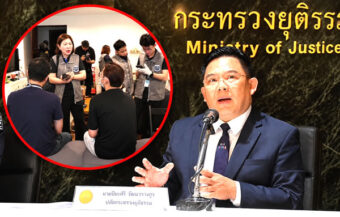
Senior Thai police announced the arrest on June 6. Among those present were Police General Thatchai Pitanilabutr, Deputy Commissioner-General of the Royal Thai Police, and Police Lieutenant General Panumas Boonyalak, Commissioner of the Immigration Bureau. Also attending were Police Major General Panthana Nuchanart, Deputy Commissioner of the Immigration Bureau, Police Major General Thanit Thaiwatcharamas, Deputy Commissioner of the Immigration Bureau, and Police Major General Panop Warathanachakool, Commander of the Investigation Division. Senior Immigration Bureau commanders involved in the operation also attended the briefing.
According to investigators, the network operated from Poipet in Cambodia. From there, call centre teams allegedly targeted Japanese citizens through organised fraud schemes. As the investigation widened, Japanese police began mapping the organisation’s command structure. Eventually, they identified Mr Sasaki as the alleged mastermind behind the operation.
Notably, investigators believe the suspect maintained criminal connections across several countries. Those links prompted close cooperation between Japanese and Thai authorities. Once his presence in Thailand was confirmed, the Anti-Human Trafficking Centre tasked immigration investigators with locating him. Surveillance teams subsequently traced his movements before the arrest operation was launched in Bangkok.
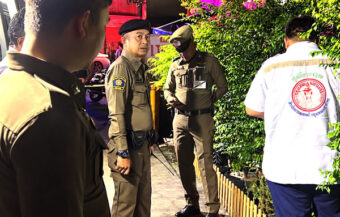
Investigators traced the fugitive’s movements in Thailand before swooping on him in a Bangkok hideout
The case stretches far beyond telephone fraud. Japanese investigators say the network was linked to larger criminal organisations operating from Cambodia.
In parallel, evidence emerged pointing to human trafficking and coercion inside the organisation. Authorities allege individuals were recruited and drawn into scam operations connected to the network.
As part of this, investigators examined information linked to the movement of people across borders. They also looked at allegations of coercion within the organisation’s structure. Those findings elevated the case beyond a conventional fraud investigation. Instead, it became a major transnational crime inquiry involving multiple agencies.
Japanese authorities say the network formed part of a wider criminal ecosystem operating from Cambodia. Investigators allege the organisation combined large-scale financial fraud with activities commonly associated with human trafficking networks. Information gathered during the probe suggested people were moved, recruited and controlled within the operation. Consequently, anti-trafficking investigators became involved alongside fraud specialists.
Separately, Thai authorities linked the arrest to the government’s broader campaign against call centre gangs. Police Major General Panthana Nuchanart said the operation followed Prime Minister Anutin Charnvirakul’s policy to eradicate call centre crime and human trafficking. The strategy combines international cooperation with aggressive enforcement against network leaders.
Under those directives, Police General Kittirat Phanphet, Commissioner-General of the Royal Thai Police, ordered closer cooperation with foreign partners. The objective is clear. Authorities want to stop Thailand from being used as a transit route for criminal networks. They also want to prevent trafficking victims from being funnelled into scam compounds in neighbouring countries.
Human trafficking allegations widened the probe into the Cambodian network beyond simple fraud claims
In response, Thai investigators have increased intelligence sharing with overseas agencies. Joint investigations have become increasingly common. Information now moves rapidly between police forces confronting the same criminal networks.
Consequently, suspects who once moved freely across borders face greater pressure from coordinated investigations. Authorities say international cooperation has become essential because many scam syndicates now operate simultaneously in several countries.
On another front, authorities continue targeting the financial and organisational structures behind scam compounds. Investigators increasingly focus on leaders rather than low-level operatives. Police believe removing senior figures causes maximum disruption. Therefore, identifying organisers and decision-makers has become a priority.
Thai authorities say call centre compounds operating in neighbouring countries often depend on sophisticated management structures. Investigators believe dismantling leadership networks can significantly weaken criminal operations. As a result, efforts increasingly focus on identifying those directing activities behind the scenes rather than those carrying out instructions.
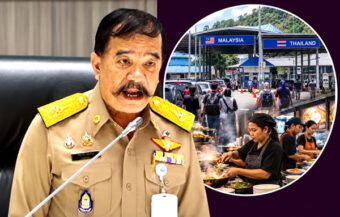
Thai police intensify regional crackdown by targeting organisers and senior criminal figures
Police General Thatchai said suppressing call centre gangs remains a key government objective. He stressed that cooperation with Japan and other countries is essential.
Such partnerships help prevent Thailand from being used as a transit point for forced labour operations. They also strengthen efforts to dismantle criminal networks operating across national borders.
Meanwhile, law enforcement agencies across Asia have intensified action against scam compounds. Recent investigations have uncovered increasingly sophisticated networks. Many operate across several jurisdictions simultaneously. As a result, international cooperation has become indispensable in pursuing suspects and gathering evidence.
The latest arrest highlights the growing reach of cross-border investigations. Information collected in one country increasingly leads to enforcement action in another. Investigators say that trend has become a defining feature of modern organised crime investigations throughout the region.
Regional police forces deepen cooperation as scam compounds face mounting international pressure
For Japanese investigators, the arrest represents a significant breakthrough. They believe the suspect occupied a senior leadership position inside the organisation. Authorities allege he helped direct operations from Cambodia while maintaining international links. Those activities are now at the centre of the Japanese criminal case against him.
For Thailand, the arrest delivers another high-profile blow against transnational organised crime. It also demonstrates the growing reach of joint investigations involving regional partners. Intelligence gathered in one country can now quickly trigger enforcement action in another.
Nest of Nigerian scammers and drug dealers raided in Nonthaburi days after prolific conman was arrested
Massive raid by Immigration on Muang Thong Thani romance scam centre sees 13 Africans arrested
At the same time, investigators continue examining the network’s wider connections. Authorities are studying its structure, operations and suspected trafficking activities. Additional inquiries remain underway. Officials have not disclosed how long Mr Sasaki had been living in Thailand before his arrest.
Ultimately, the operation ended with one of Japan’s most wanted fraud suspects in custody. The alleged leader of a billion-yen scam network now faces extradition proceedings. Once those procedures are completed, he will be handed over to Japanese police. There, he will face legal action under the Nagoya Court warrant issued earlier this year.
Join the Thai News forum, follow Thai Examiner on Facebook here
Receive all our stories as they come out on Telegram here
Follow Thai Examiner here
Further reading:
Money Laundering Office seizes assets with money trail linked to South African financier Ben Smith
Kla Tham MP dismisses unproven scam centre claims about Deputy Prime Minister Thamanat Prompow
People’s Party warns Anutin of a No Confidence move over cabinet links to Cambodian scam networks
United States, South Korea and United Kingdom act against Cambodian scam industry with Thai tie-ins
Ben Smith affair & allegations of links to Cambodian scam centres continues to rage in parliament
Defiant Rangsiman Rome warns he’s not just fighting a defamation case but for the future of Thailand