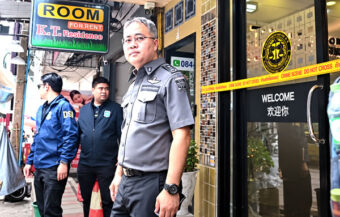
Bangkok sinkhole probe complete but still secret as scrutiny grows over metro works, political links and safety failures after the collapse shut down a city centre area, triggered a probe and forced demolition of a ฿40 million police station.
A high-stakes government report into Bangkok’s Samsen Road sinkhole collapse is complete but still under wraps, as scrutiny intensifies over metro tunnelling, political links, and oversight failures. The collapse paralysed central Bangkok on the day Anutin Charnvirakul took office, forcing evacuations, closures, and the demolition of a new police station, while triggering a police probe and demands for accountability. Now, with findings awaiting approval from Phiphat Ratchakitprakarn, the question of cause and responsibility remains unresolved.
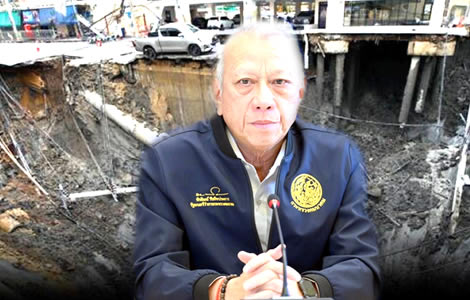
A long-awaited report into the Bangkok sinkhole collapse last September is approaching release, but it remains under formal review. The findings have already been submitted to the Ministry of Transport, and they are now moving through internal procedures.
Subsequently, the report will be presented to Phiphat Ratchakitprakarn for final approval. Only after that process is complete can officials hold a formal press briefing. For now, however, authorities have declined to disclose any details.
The collapse occurred on September 24, 2025, on Samsen Road in central Bangkok. Specifically, the sinkhole opened directly in front of Vajira Hospital. As a result, traffic halted immediately across the Dusit district, and congestion spread quickly.
Sinkhole collapse in central Bangkok halts traffic and triggers disruption across Dusit district
Meanwhile, residents were evacuated from nearby buildings as a precaution. In addition, several businesses were forced to shut down without notice. Consequently, the disruption was both immediate and widespread.
Notably, the incident coincided with a major political event. On the same day, Anutin Charnvirakul swore in his first cabinet at Dusit Palace. Therefore, the timing intensified attention both domestically and internationally. Within hours, the collapse was reported by global media outlets. As a result, the incident became a focal point for scrutiny of Bangkok’s infrastructure.
On Monday, April 27, officials confirmed that the investigation had been completed. At the Department of Rail Transport, Deputy Permanent Secretary Panya Chupanich outlined the process. He stated that academics and technical experts participated extensively.
Moreover, they conducted a detailed and structured study into the causes. The completed report was then forwarded to the ministry for review. However, it must still pass several formal stages before reaching the minister.
Meanwhile, the cause of the collapse has not been publicly confirmed. However, critics have consistently linked the incident to underground construction activity. In particular, attention has focused on tunnelling work for new metro stations near the site. These works fall under the Mass Rapid Transit Authority of Thailand. Therefore, questions about construction practices have remained central to the debate.
Engineers and critics question tunnelling works and demand transparency over cause of collapse
Since the collapse, scrutiny has been sustained and vocal. Engineers and former city officials have demanded clear answers. In particular, they have called for technical transparency and full disclosure.
Furthermore, they have questioned whether proper engineering standards were followed. As a result, the investigation has drawn intense public and professional interest.
Among the most prominent voices is former Bangkok deputy governor Samart Ratchapolsit. He rejected early explanations that pointed to natural causes. Instead, he argued that underground construction activity was the likely trigger. Consequently, he called for a full and rigorous technical investigation. He insisted that all engineering processes must be examined in detail.
Specifically, he questioned the integrity of tunnel-station junctions. He asked whether jet grouting had been properly carried out at these points. This process is essential for sealing soil and preventing water infiltration. Without it, underground cavities can form and expand. Therefore, he argued that any failure in this process could be critical.
Moreover, he criticised official statements for lacking technical data. He noted that no comparative soil analysis had been presented. Consequently, he warned that conclusions might be incomplete or misleading. He also stressed that attributing the collapse to natural causes alone was insufficient. In addition, he pointed out that nearby stations built under similar conditions had not failed.
Contractor links and emergency response measures intensify scrutiny after major urban collapse
Attention has also turned to the contractor involved in the project. The construction work was being carried out by a consortium. Notably, the consortium includes a firm linked to the prime minister’s family. As a result, critics raised concerns about potential political influence. Therefore, calls for accountability intensified.
Immediately after the collapse, emergency crews were deployed to stabilise the area. They began by pouring approximately 700 cubic metres of concrete into the affected zone. Subsequently, authorities increased this to 1,000 cubic metres.
In addition, a concrete wall was constructed to reinforce the tunnel structure. These measures aimed to prevent further subsidence.
Meanwhile, engineers inspected hollow sections of the tunnel. At the same time, monitoring systems were installed across the site. These systems tracked soil movement and structural vibrations continuously. Equipment from Kasetsart University and Chulalongkorn University was brought into use. Consequently, authorities were able to detect any instability in real time.
Police probe damage reports and restrict access as engineers monitor tunnel stability risks closely
Access to the surrounding areas remained restricted for a week. This includes residential flats and a nearby police station. Furthermore, a cracked tunnel section measuring about 30 square metres is under close inspection. Officials worked hard to ensure that no further collapse occurs. Therefore, safety measures remain firmly in place.
In parallel, the Royal Thai Police launched an investigation into the incident. Officers living in nearby accommodation reported damage to property. Vehicles and residential units were affected by the collapse. Consequently, formal complaints were filed. Officials previously stated that any charges would depend on engineering findings.
Investigators must determine whether negligence played a role. However, the conclusions of this report have not yet been made public. Therefore, the legal outcome remains uncertain.
Governor confirms hospital reopening while demolition follows damage to newly built police station
Popular Bangkok Governor Chadchart Sittipunt took control last September and provided regular updates. He was quickly able to confirm that Vajira Hospital had fully reopened. Outpatient services resumed after engineers completed safety checks. They verified that foundation piles and retaining walls were secure. In addition, water supply to the affected area has been restored.
The newly built police station, however, was not so lucky. It had to be demolished. The building had previously cost ฿40 million of taxpayers’ money.
However, minor soil movement continued near the site. Therefore, monitoring remains active and continuous. Authorities confirmed that stabilisation work was ongoing. Consequently, access restrictions remained in place until the area was eventually declared fully secure.
The collapse attracted widespread international attention. As a result, it raised questions about infrastructure safety in Bangkok. Many officials expressed concern about the city’s reputation. In particular, those with engineering backgrounds spoke out. They emphasised the need for clear, data-driven explanations.
Political criticism grows as public concern intensifies over transparency and infrastructure oversight failures
Political reaction followed quickly. Prompong Nopparit of the Pheu Thai Party criticised the lack of parliamentary debate. He questioned whether oversight of infrastructure projects was sufficient. Furthermore, he raised concerns about government priorities. Therefore, he called for stronger supervision and accountability.
Public concern has remained high throughout the investigation. Residents expressed frustration over limited information. In particular, they criticised the lack of technical transparency. Online discussions focused heavily on accountability. Consequently, pressure on authorities has remained high.
Meanwhile, remediation work continues at the site. Engineers have reinforced structures and sealed tunnel sections. Monitoring systems are active at all times. Therefore, risks have been carefully managed. Authorities have stated that all measures taken followed strict engineering standards.
Despite the scale of the incident, luckily, no injuries were reported. However, property damage was extensive and visible. Personal vehicles and buildings were damaged, in addition to infrastructure.
Investigation awaits release as authorities review findings and broader infrastructure concerns emerge
The completed investigation is expected to provide definitive findings. It is expected to determine the exact cause of the collapse. In addition, it will assess construction practices and oversight. However, the report remains confidential pending approval. Therefore, no official conclusions have yet been released.
For now, the Samsen Road site remains under close observation. Engineers continue detailed inspections of the tunnel and surrounding soil. Monitoring systems track every movement continuously. Consequently, authorities remain on alert.
Just another accident or disaster on Saturday as Thailand’s image abroad takes a battering this week
Ex Bangkok deputy governor demands that proper responsibility be taken for the Samsen Road sinkhole
The report’s eventual release is expected to clarify key issues. It will address both technical and operational factors. Until then, scrutiny remains high. The investigation has concluded, but its findings are still under review. They are eagerly awaited.
This incident has since been linked with a number of serious accidents and engineering disasters linked with the country’s vast infrastructure programmes. It includes a major railway accident on the new high-speed rail link to China, in addition to ongoing collapses in structures linked with motorway developments.
Join the Thai News forum, follow Thai Examiner on Facebook here
Receive all our stories as they come out on Telegram here
Follow Thai Examiner here
Further reading:
Just another accident or disaster on Saturday as Thailand’s image abroad takes a battering this week
Italian Thai boss and 16 others arrested on Thursday charged with Auditor General building deaths
Arrested man linked with Chatuchak building collapse now tells police he is a Chinese state employee
Prime Minister orders arrests over the Chatuchak Auditor General building disaster within seven days
Chinese steel firm linked to Chatuchak disaster faces DSI probes. Minister cancels investment status
Storm clouds gathering over Chinese firm at the centre of the collapsed Chatuchak building disaster
US scan shows 50-60 human beings said to be in a hallway within the collapsed Chatuchak building