Another EV fire has rocked Thailand after a Bangkok-registered electric car exploded into flames in Phichit, just 90 minutes after a blaze destroyed three homes nearby. The dramatic incident adds to the growing scrutiny of EV safety as vehicle fires mount.
A Bangkok-registered electric vehicle erupted into flames and was destroyed in Phichit on Saturday night just 90 minutes after firefighters battled a major blaze that gutted three homes nearby, forcing crews to split resources between two emergencies. The dramatic fire comes as Thailand’s booming EV market faces mounting scrutiny following a series of vehicle fires nationwide, with investigators examining battery safety, charging systems and the challenges of tackling lithium-ion battery blazes.
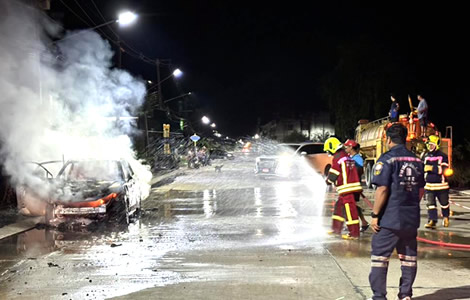
Thailand witnessed another electric vehicle fire on Saturday night after a Bangkok-registered EV erupted in flames in Phichit province.
The vehicle was completely destroyed. Earlier that day, the owner had reported problems while driving. She was subsequently advised to leave the car parked and await collection for inspection.
The incident unfolded in Taphan Hin municipality in lower northern Thailand. Notably, it came less than 90 minutes after firefighters tackled a major house fire nearby. As a result, emergency crews were forced to divide resources between two significant blazes in the same district.
Three homes destroyed as strong winds spread a blaze through tightly packed wooden houses in Phichit
Police and rescue workers were first alerted shortly after 8 pm to a fire in the Phrom Jai community. Fire engines from Taphan Hin Municipality were dispatched immediately.
However, crews arrived to find flames already sweeping through closely packed wooden homes. Strong winds further fuelled the fire. Consequently, firefighters faced a rapidly deteriorating situation.
The blaze spread through three properties identified as houses numbered 45/1, 44/2 and 44/3. In response, municipal officials requested reinforcements from neighbouring jurisdictions. More than 10 additional fire engines were dispatched from nearby municipalities and subdistrict administrations. Meanwhile, residents attempted to move belongings from threatened homes as crews fought to contain the flames.
For almost an hour, firefighters battled the blaze. Eventually, they prevented it from spreading further through the community. Fortunately, no deaths or injuries were reported. Nevertheless, three homes suffered extensive damage.
Forensic police examine the suspected source of the blaze as local officials inspect destroyed homes
After the fire was extinguished, senior local officials inspected the scene. The Taphan Hin district chief joined the municipality’s mayor in examining the affected area. During the inspection, investigators focused attention on the house believed to be the source of the fire.
Officials found the property was unoccupied at the time. However, it contained a substantial quantity of recyclable waste. As part of the investigation, that material is being examined as a possible factor in the blaze.
Separately, forensic police from Phichit province are expected to conduct a detailed inspection to determine the exact cause. Municipal authorities later said assistance would be provided to affected families.
Before operations connected with the house fire had fully concluded, another emergency erupted. At 9.25pm, firefighters received reports of a vehicle fire in Hanuman Soi, also within Taphan Hin municipality. This time, the incident involved an electric vehicle parked beside the road.
Firefighters diverted engines from a house blaze after a parked Bangkok EV erupted into flames nearby
The Bangkok-registered EV suddenly burst into flames. As a consequence, two fire engines still deployed from the earlier operation were redirected to the scene. Firefighters arrived to find the vehicle engulfed.
Crews soon encountered difficulties controlling the blaze. According to reports from the scene, direct attempts to extinguish the flames appeared to intensify the fire. Therefore, firefighters adjusted their approach. Instead of attacking the centre of the blaze directly, crews concentrated on cooling surrounding areas and preventing the fire from spreading.
Even so, the vehicle continued burning intensely. Eventually, firefighters brought the situation under control. By that stage, however, the EV had been reduced to a burnt-out shell. Images from the scene showed severe fire damage throughout the vehicle, with only its charred structure remaining.
The owner later described events leading up to the fire. Earlier on Saturday, she noticed the vehicle behaving abnormally while driving. Concerned by the problem, she contacted her insurance company. Following that consultation, she was advised not to continue using the vehicle.
Owner reported vehicle problems earlier before the insurer arranged collection and inspection
Instead, arrangements were made for a flatbed truck to collect the car on Sunday. Until then, she was instructed to leave it parked outside her home.
However, the vehicle caught fire before recovery personnel could arrive. According to MGR Online, the blaze erupted while the EV remained parked on the roadside awaiting collection.
The Phichit incident is the latest in a series of electric vehicle fires reported in Thailand over the past year. Consequently, questions surrounding battery safety and charging systems have attracted increasing attention. At the same time, EV ownership has expanded rapidly across the country.
Thailand has become Southeast Asia’s largest electric vehicle market. Government incentives have encouraged adoption. In parallel, major investments from Chinese manufacturers have increased production and sales. Thousands of motorists have switched from conventional petrol-powered vehicles to electric models. Lower operating costs have been a major attraction.
Despite that growth, several fires have drawn public attention. Earlier this month, a BYD Dolphin caught fire while charging at a house in Khon Kaen province.
The blaze spread from the vehicle to the property, causing extensive damage. Subsequently, the incident generated widespread discussion online and prompted a detailed investigation.
Series of EV fires across Thailand prompts scrutiny of battery charging systems and safety
The manufacturer later said preliminary findings suggested the fire may not have originated within the vehicle itself. Instead, investigators focused on an external charging system and associated electrical equipment. The inquiry examined charging hardware and household electrical circuits connected to the vehicle.
On another front, authorities in March launched an investigation after a Volvo EX30 caught fire while parked at a Bangkok residence. The incident attracted national attention. Consumer protection officials later sought explanations from the manufacturer regarding the circumstances of the fire.
Earlier this year, reports also emerged of an MG IM6 catching fire while charging at a home in Nakhon Pathom shortly after purchase. Collectively, these incidents have placed greater scrutiny on vehicle batteries, charging equipment and emergency response procedures.
Experts note that EV fires remain relatively uncommon compared with the number of vehicles on the road. Nevertheless, battery fires can present different challenges. Lithium-ion battery systems can experience what engineers describe as “thermal runaway”. In such cases, a chain reaction develops within battery cells, generating intense heat.
Battery fires pose unique challenges as damaged cells can continue generating dangerous heat
As temperatures rise, damaged battery packs can continue producing heat even after flames appear extinguished. Consequently, firefighters may face prolonged operations.
Large quantities of water are often required to cool battery systems. In addition, damaged vehicles may require monitoring long after the initial fire has been contained.
Khon Kaen Police probing a pre dawn blaze caused by a charging EV that burned down a family home
Volvo withdraws one of its EV models in a disastrous week for the firm in Thailand with exploding cars
Emergency services in Thailand have adapted procedures as EV ownership has increased. Training and operational tactics have evolved accordingly. Meanwhile, government policy continues to support the expansion of the country’s electric vehicle sector and manufacturing base.
For now, investigators are working to establish precisely what caused Saturday night’s vehicle fire. Meanwhile, residents in Taphan Hin are recovering from an evening that saw two major fires strike the same municipality within little more than an hour. The first destroyed three homes. The second reduced an electric vehicle to twisted metal and ash.
Join the Thai News forum, follow Thai Examiner on Facebook here
Receive all our stories as they come out on Telegram here
Follow Thai Examiner here
Further reading:
Khon Kaen Police probing a pre dawn blaze caused by a charging EV that burned down a family home
Government sends strong warning to EV industry after a dramatic surge in consumer complaints
Thaksin wants higher excise duties on EV cars that are simply assembled in Thailand by Chinese firms
EV sector crisis as Chinese firms are trapped between lack of demand and government tax penalties
Thailand changes tack as EV revolution turns into a damp squib with warehouses full of unsold cars
Top Thai insurer says no more new policies for EV cars. Later, it emphasised renewals case by case