
Anutin Charnvirakul is blindsided by the US-Iran war as oil nears $100, inflation surges toward 3.5%, and foreign investors flee, exposing Thailand’s deep energy reliance and shattering hopes of a post-election economic recovery now under pressure.
Thailand’s Prime Minister Anutin Charnvirakul on Wednesday floated faster progress on the kingdom’s Net Zero targets and United Nations development goals, driven by an energy crisis linked to the Middle East war. It sounds good—but the real challenge is a looming 3.5% inflation rate in 2026 and mounting pressure that could force sharp electricity price hikes. The newly re-elected Prime Minister now faces the stark prospect of an economic crisis beyond his control—one that could erode public support quickly if the conflict drags on.
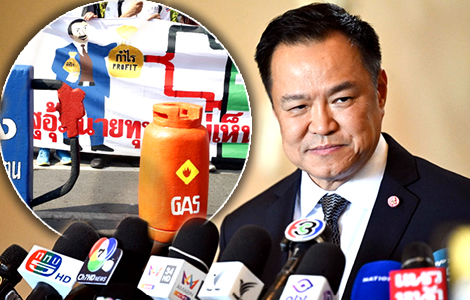
Prime Minister Anutin Charnvirakul and his government have been caught off guard by the US-Iran war and a deepening global energy shock. As a result, the administration now faces rising inflation and tightening financial conditions.
Moreover, the crisis has escalated rapidly since late February, disrupting earlier expectations of recovery. Initially, the government had anticipated stability after the general election. However, the conflict quickly reversed that outlook and introduced fresh uncertainty across the economy.
At the same time, inflation pressures are building across multiple sectors. The government is already confronting a sharp rise in prices. Furthermore, analysts warn that inflation could intensify if the conflict continues. Forecasts now indicate inflation may reach 3.5% this year. This marks a sharp contrast to a 0.54% contraction in the first quarter. Consequently, the shift underscores the speed and scale of the economic shock.
Thailand faces rising inflation and economic disruption as conflict reverses post-election recovery outlook
On Wednesday, Mr Anutin participated in an online summit chaired by Japanese Prime Minister Sanae Takaichi. During the Asia Zero Emission Community meeting, regional leaders addressed energy challenges. There, Mr Anutin delivered a brief national statement outlining Thailand’s position.
He emphasised adaptation and resilience in response to the crisis. In particular, he said Thailand would accelerate its ‘Net Zero’ targets under the United Nations framework.
Furthermore, he stated that Thailand must restructure domestic energy use to ensure security. He also stressed the need to prevent hardship for the population.
In addition, he confirmed that alternative energy sources would be explored. Meanwhile, he insisted that Thailand would maintain continuity in energy supply. Therefore, the government is framing the crisis as an opportunity for transition. However, such a shift implies significant structural change.
Government pushes net zero strategy and energy reform as crisis forces shift in national policy direction
Thailand, meanwhile, remains heavily dependent on imported fossil fuels. As a result, any rapid transition will require substantial investment and planning. Moreover, infrastructure constraints could limit the pace of change.
At the same time, domestic pressure is rising as energy costs remain sensitive. Consequently, any increase in electricity tariffs risks public backlash. Similarly, trends in the United States and Europe suggest voters may resist higher energy costs.
Meanwhile, the crisis has exposed Thailand’s reliance on Middle Eastern energy supplies. Data from Kasikorn Research Centre shows that 51% of crude imports come from the region. In addition, broader estimates indicate heavy dependence on Gulf oil and gas.
Therefore, global supply disruptions have immediate domestic consequences. Oil prices have already surged to near $100 per barrel. As a result, import costs have risen sharply, and inflation expectations have shifted.
Heavy reliance on Middle Eastern oil leaves Thailand exposed as global prices surge towards $100 per barrel
Financial markets have reacted quickly to these developments. Initially, February saw renewed investor confidence in Thailand. Foreign investors purchased $7 billion in Thai equities during that month.
This followed Mr Anutin’s decisive election victory. His party, the Bhumjaithai Party, secured a strong mandate. Consequently, expectations of political stability and reform increased. The Stock Exchange of Thailand and short-term capital inflows both strengthened.
However, the outbreak of war triggered a rapid reversal. In March, foreign investors sold $823 million in equities. At the same time, bond markets recorded $705 million in outflows. This marked the largest combined outflow since October 2024. As a result, earlier gains were quickly erased. Although a temporary ceasefire has provided some relief, caution remains dominant among investors.
Moreover, analysts warn that the energy shock is not fully priced into markets. Higher fuel costs could weigh on consumption. In addition, exports and tourism may face disruption. These sectors are key drivers of Thailand’s economy. Therefore, prolonged high energy prices would have a broad economic impact. Before the conflict, economic growth had already been weak. Thailand expanded by just 2.4% last year, lagging regional peers.
Investor confidence reverses sharply as foreign funds exit Thailand amid rising energy costs and uncertainty
At the same time, monetary policy options are constrained. The central bank had cut interest rates in February due to deflation. However, rising inflation now complicates further easing. Conversely, tightening policy risks undermining recovery. Therefore, policymakers face a narrow path forward. Analysts describe the situation as a policy bind with limited flexibility.
Fiscal pressures are also mounting. Public debt stands at 66% of GDP, close to the 70% ceiling. Consequently, the government has limited borrowing capacity. Discussions have emerged about raising the ceiling to 75%. This would fall under the State Fiscal and Financial Disciplines Act 2018. However, such a move could trigger public concern over fiscal discipline. Rising debt and inflation together may erode confidence.
Meanwhile, the government is attempting to contain energy costs. It is trying to keep electricity tariffs within preset limits. This approach aims to protect households from immediate impact. However, it also increases fiscal strain.
Notably, authorities have ruled out fuel subsidies for now. Each increase in fuel prices reduces economic growth. Estimates suggest a one baht rise cuts growth by two basis points.
Limited policy options as rising debt and inflation constrain government response to escalating crisis
Externally, geopolitical risks remain elevated. The conflict involves Iran, the United States, and Israel. In addition, attention is focused on the Strait of Hormuz. Continued disruption there is presently impacting global oil supply. If the United States blockade settles in, prices could rise sharply. Consequently, Thailand would face immediate cost pressures and rising inflation. Therefore, risks remain tilted to the upside.
Currency markets reflect these pressures. The Thai baht has weakened by around 2.8% since the conflict began. However, it has recovered some losses following the ceasefire. Nevertheless, volatility remains elevated. Earlier in 2025, the baht had gained 9%, providing some buffer. Yet further depreciation remains possible if conditions worsen.
At the same time, regional currencies face similar challenges. The Philippine peso and Indonesian rupiah have weakened to record levels. Therefore, Thailand is not alone in facing external pressures. However, its energy dependence makes it particularly exposed. Consequently, the impact of the shock may be more pronounced.
The banking sector is also under pressure. Profitability is being eroded by rising risks. In addition, the global environment has become more volatile. Therefore, financial institutions face increased uncertainty. Lending conditions may tighten as a result. This could further slow economic activity in the months ahead.
Geopolitical tensions and currency pressure deepen risks as banks face rising uncertainty and weaker outlook
In parallel, Thailand continues to pursue long-term economic goals. The government aims to join the OECD by 2030. The accession process began in 2024. However, membership requires extensive reforms and institutional alignment. More than 200 international standards must be met.
Recent reviews acknowledge progress in policy design. However, gaps remain in enforcement and implementation. In particular, weaknesses persist in transparency and accountability. Conflict-of-interest management also requires improvement. Therefore, further reforms are necessary to meet OECD standards.
IMF warns of slow growth as S&P express concern about Thailand’s banking system amid uncertainty
Budget Bureau warns Finance Minister that Thailand’s economy faces acute crisis with rising public debt
Public participation has also come under scrutiny. Large infrastructure projects have faced criticism over transparency. Concerns centre on access to information and decision-making processes. These issues may affect investor confidence over time. Meanwhile, the government continues to emphasise its commitment to reform.
Overall, the crisis has fundamentally altered Thailand’s economic outlook. Earlier optimism following the election has faded quickly. Instead, inflation, energy costs, and capital outflows now dominate the landscape.
The government and the Prime Minister are now exposed. Soundbites about Net Zero and the United Nations goal will not cut it with Thai voters if the cost of living rises with money in short supply.
Join the Thai News forum, follow Thai Examiner on Facebook here
Receive all our stories as they come out on Telegram here
Follow Thai Examiner here
Further reading:
IMF warns of slow growth as S&P express concern about Thailand’s banking system amid uncertainty
60-day visa regime to be ended confirms Minister responding to rising industry security concerns
Tourism boss warns Thailand it is facing a Chinese blacklist if another security controversy erupts
Visa waiver scheme questioned with another China Crisis for foreign tourism driven by security fears