Thailand pushes tourist tax again with insurance as arrivals fall and recovery stalls. New minister warns the rebound may take four years amid weak demand, policy shifts, global turmoil and mounting pressure on the tourism sector. These include higher air fares, rising prices in hotspots and public discontent.
Thailand’s sixth Minister of Tourism and Sports since 2023 has, like his predecessors, moved to introduce a foreign tourist levy on arrivals. In the latest announcement, Surasak Phanjaroenworakul says the levy will include automatic insurance cover for foreign tourists. This follows last week’s statement that insurance will become mandatory for all incoming visitors under the new government. The minister said on Monday that it will take at least four years to restore foreign tourism revenue to 2019 levels. This comes as projections show that second-quarter 2026 figures are set to be 9.4% lower than those in 2025.
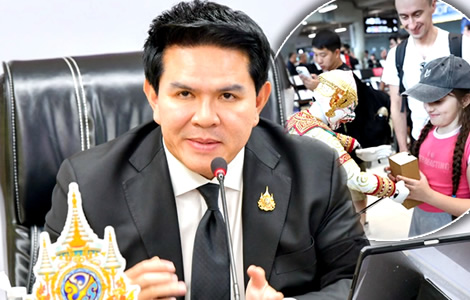
Thailand’s Minister of Tourism and Sports has again pledged to introduce a foreign tourist levy, marking another policy shift within a short period. He is the sixth minister to hold the office since mid-2023.
In a change from recent statements, he said the levy will include automatic insurance for arrivals entering Thailand. Previously, reports indicated insurance could become mandatory for all visitors or visa applicants. However, the current approach links insurance directly to the proposed fee. As a result, the policy now combines revenue generation with visitor protection measures.
Significantly, this proposal has been mooted in a different shape and form by Thai governments since at least 2015, or over a decade. It has never materialised. The closest it came to implementation was in the later stages of the government of General Prayut Chan-o-cha. Then it failed when airlines refused to collect the charge.
Minister confirms levy with insurance as tourism struggles and recovery timeline extends to four years
Over the weekend, Mr Surasak confirmed the revised position and outlined the sector’s outlook. He said the tourism industry has not regained its strength since the 2020 airspace closure during COVID-19. Moreover, he stated that a full recovery may take another four years.
This timeline reflects ongoing structural weakness in the sector. At the same time, recent data shows a clear downturn in performance. Visitor numbers fell by 7.2% in 2025, reversing earlier gains. Consequently, the government has adjusted its strategy and messaging.
Meanwhile, Prime Minister Anutin Charnvirakul confirmed a shift in policy direction. In a statement to parliament last week, he said the government will no longer pursue high visitor volumes. Instead, it will prioritise revenue generation. Previously, Thailand focused on expanding arrival numbers.
Indeed, arrivals quadrupled between 2000 and 2019. Tourism became a central economic driver during that period. However, current projections indicate a slower and more uncertain recovery path.
Forecasts show declining arrivals as Thailand shifts focus from volume to revenue amid a weak outlook
Accordingly, forecasts for 2026 remain below pre-pandemic benchmarks. Total arrivals are expected to reach about 30 million. This is 9.4% below the 33 million recorded in 2019. Furthermore, some analysts suggest arrivals could fall to 28 million.
That would represent a decline of about 15%. However, these projections contrast with the government’s stated objectives. While officials promote high-value tourism, actual trends show reliance on short-haul markets. In particular, China and Malaysia dominate visitor flows. These segments are widely considered lower spenders.
At the same time, regional declines are becoming more pronounced. Arrivals from the Middle East have dropped by over 33%. Meanwhile, long-haul European travel has weakened significantly. This is linked to the ongoing Middle East conflict. Consequently, travel costs have risen due to higher oil prices.
Airfares have also increased, adding pressure on demand. Moreover, Thailand is becoming more expensive as a destination. Airport charges will rise by 53% in May, reaching ฿430 per traveller. As a result, combined cost pressures are weighing on travel decisions.
Falling flight volumes, rising costs and public backlash add pressure on Thailand’s tourism sector
In addition, industry indicators point to weakening demand. Flight volumes from several markets have declined by more than 10%. This reflects reduced travel confidence and higher operating costs.
At the same time, geopolitical uncertainty continues to influence global travel patterns. These external factors are now feeding into Thailand’s tourism performance. Therefore, the sector faces both cyclical and structural pressures.
Domestic sentiment is also shifting. Local populations have become increasingly vocal about tourism impacts. Reports of misconduct by foreign visitors have gained attention online. In particular, Phuket has seen frequent public reactions. Residents often respond strongly to reports of antisocial behaviour. Incidents range from minor disturbances to violent brawls. Consequently, public frustration has become more visible across digital platforms.
Meanwhile, negative coverage involving foreign tourists continues to circulate widely. Reports of accidents and deaths involving visitors remain frequent. In many cases, these incidents highlight financial difficulties faced by families. Medical treatment costs can be high, while repatriation expenses add further strain. As a result, such cases often gain attention in both local and international media.
Visa instability limited high value gains and shifting visitor behaviour challenge government strategy
At the same time, visa policy remains in flux. Regulations have changed repeatedly in recent years. A more open approach was introduced under former Prime Minister Srettha Thavisin. However, that policy is now being reversed. Consequently, frequent changes have created uncertainty for travellers and industry operators alike.
Despite these conditions, the government continues to emphasise high-value tourism. This approach focuses on attracting higher-spending visitors. However, previous efforts have produced limited results. High-spending tourists remain a relatively small segment. Their numbers have not matched policy expectations. Nevertheless, the strategy remains central to current planning.
In parallel, officials continue to promote cultural tourism. They argue this will increase visitor value. However, travel patterns suggest different motivations dominate. Many visitors prioritise leisure, climate, and entertainment. For example, Thailand’s beaches remain a primary attraction. The entertainment sector also plays a major role. Although cultural sites are visited, they are not always the main draw.
Revenue targets persist as tourism recovery lags and reliance on levy and external demand increases
Consequently, there is a gap between policy messaging and visitor behaviour. This gap is particularly evident among Western travellers. Many seek sunshine and leisure experiences rather than cultural immersion. Therefore, actual demand patterns continue to diverge from official priorities.
Meanwhile, the ministry has set a clear revenue target. It aims to exceed 3 trillion baht within four years. This would surpass pre-pandemic levels. In 2019, Thailand recorded about 40 million visitors and 3 trillion baht in revenue. These figures remain the benchmark for recovery. However, current data suggests progress will be gradual.
In 2025, Thailand recorded 33 million foreign arrivals, down 7% from the previous year. Total tourism revenue reached 2.7 trillion baht, including domestic travel. This represented a decline of about 1.3%. Therefore, the proposed 300-baht levy forms part of a broader recovery strategy. Mr Surasak confirmed the measure will proceed. Revenue will be allocated to a tourism development fund and visitor insurance.
He noted that similar schemes are used internationally. For example, Japan has implemented a departure tax. It has also announced plans to increase that charge. Accordingly, Thailand’s proposal follows established international practices.
Short term stimulus and restructuring plans aim to offset slowdown and stabilise tourism sector performance
In the short term, the ministry plans to introduce stimulus measures. These are aimed at supporting tourism over the next three to six months. This follows expectations of weaker performance after the Songkran period.
“After Songkran, tourism performance is expected to worsen further,” Mr Surasak said. Therefore, the government plans to revive co-payment schemes to boost domestic spending.
In addition, tax incentives are under consideration. Authorities will also encourage the use of public transport. For instance, programmes may promote rail travel to stimulate domestic tourism. These measures are intended to offset declines in foreign arrivals during the low season.
Over the longer term, structural reforms are also planned. The government intends to merge tourism with the culture ministry. At the same time, a separate ministry for sports is proposed. Officials say this restructuring will improve coordination and policy execution. Meanwhile, broader goals include promoting year-round tourism and supporting local communities.
Mixed weekly data masks weakening trends as short-haul gains fail to offset broader global declines
The ministry is also emphasising green and sustainable tourism. At the same time, safety remains a priority. Officials aim to build confidence among foreign visitors. These measures reflect ongoing concerns about travel risks and perceptions.
Recent data shows mixed short-term performance. During the week of April 6 to 12, 2026, Thailand recorded 619,481 foreign arrivals. This marked an 8.76% increase from the previous week. The rise was driven by the Songkran holiday period. Notably, short-haul markets accounted for around 400,000 visitors. This represented an 18.32% weekly increase.
China remained the largest source market with 106,504 arrivals. Malaysia followed with 90,524 visitors, while India recorded 53,308 arrivals. Meanwhile, Russia and the United States completed the top five. They recorded 36,701 and 24,693 arrivals, respectively. Growth rates varied across markets, reflecting uneven demand.
For example, Malaysian arrivals rose by 61.68%, while Chinese arrivals increased by 25.39%. The United States and India also recorded gains. However, Russian arrivals declined by 11.57%. Consequently, overall performance remains mixed across different regions.
Slowing arrivals, rising costs and global instability signal a fragile outlook for Thailand’s tourism sector
The weekly average stood at 88,498 visitors per day. As of April 13, total arrivals reached 10,363,660. Tourism revenue over that period totalled approximately 506.12 billion baht. China remains the top source market year to date, followed by Malaysia, Russia, India, and South Korea.
However, underlying trends indicate slowing momentum. Between April 1 and 5, arrivals totalled about 430,000. This was down 2.4% from the same period last year. Notably, this marked the first contraction in two months. Therefore, it signals a shift in market direction after earlier growth.
At the same time, external pressures are intensifying. The Middle East crisis has escalated since March 2026. As a result, it has affected both travel confidence and costs. Arrivals from the Middle East have dropped by 33.3%. Meanwhile, African markets declined by 6.3%, and European arrivals fell by 4.2%.
However, some regions continue to show growth. East Asia recorded a 16.1% increase, while Oceania rose by 8.6%. South Asia also increased by 8.5%. Even so, these gains have not offset declines elsewhere. Therefore, overall momentum remains weak heading into the second quarter.
Revenue targets remain as recovery stalls amid global risks domestic challenges and policy uncertainty
Looking ahead, second-quarter arrivals are projected at 6.49 million. This represents a 9.2% decline year on year. It is also significantly lower than the 9.32 million recorded in the first quarter. Consequently, the slowdown may affect broader economic recovery.
In addition, flight capacity remains under pressure. Services from several countries are down by more than 10% compared to pre-conflict levels. High oil prices continue to raise airline costs. As a result, fares may increase further, adding to demand constraints.
Taken together, these factors highlight structural vulnerabilities in the sector. Thailand’s tourism industry remains heavily dependent on foreign holidaymakers. Therefore, it is sensitive to external shocks and global conditions. If current trends persist, forecasts may be revised downward.
Nevertheless, the government continues to pursue its revenue target. It aims to exceed 3 trillion baht within four years. In effect, this is 2 trillion baht for foreign tourism revenue. The figure was almost achieved in 2019. Notably, the fall from then was caused by COVID-19, although the Thai government’s draconian reaction is widely held to have damaged the economy.
However, the recovery, which in 2023 and 2024 was thought to be guaranteed, stalled in 2025. The increasingly intense geopolitical stage across the world, in addition to Thailand’s own problems, such as its ageing population and the kingdom’s competitiveness, does impact foreign tourism.
Hardline foreign tourism confirmed by new minster. More charges, shorter visas and mandatory insurance
People’s Party MP raises questions about long queues at Phuket International Airport and fast-track lanes
Immigration Bureau warns that rip-off entry TDAC sites stand to make up to $100 million from visitors
At the same time, constant government interference and negative publicity concerning the country are undeniably factors.
Join the Thai News forum, follow Thai Examiner on Facebook here
Receive all our stories as they come out on Telegram here
Follow Thai Examiner here
Further reading:
60-day visa regime to be ended confirms Minister responding to rising industry security concerns
Tourism boss warns Thailand it is facing a Chinese blacklist if another security controversy erupts
Visa waiver scheme questioned with another China Crisis for foreign tourism driven by security fears
Tourism cryptocurrency sandbox payment plan is bound to face stiff opposition from the central bank
Thaksin calls for crypto-based bonds. Notes success and beauty of Isan women who marry foreigners
Future Bank of Thailand Chairman Pick warns that the Thai economy faces ‘disaster’ without rate cuts