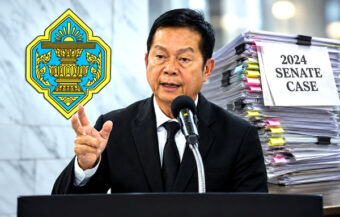
Anutin Charnvirakul heads for reelection as Thai PM with over 292 votes expected, but the Constitutional Court’s 6–3 move to probe QR and barcode ballots now threatens the Feb 8 poll, the new government. It could trigger a political crisis and costly new election.
Prime Minister Anutin Charnvirakul is expected to move on to form his new cabinet from Thursday after being reelected Prime Minister by MPs. However, a vote by the Constitutional Court on Wednesday has immediately cast a threat over his government’s future and the country’s political stability. The court appears to be moving fast to examine what are seen as strong and compelling grounds to declare the use of QR and bar codes in the February 8 election illegal, consequently annulling the poll and everything flowing from it. This would include the new House of Representatives and any cabinet formed. The ruling party is gambling that the court will not overturn the election. It is another Sword of Damocles over the country’s government, political stability and confidence.
Anutin Charnvirakul is expected to be reelected as Thai Prime Minister on Thursday with a commanding parliamentary majority. Estimates indicate support exceeding 292 votes in the House of Representatives.
Meanwhile, attention has shifted to cabinet formation scheduled for April. However, a legal challenge has entered the political timeline just days before the expected vote. As a result, the transition to the next government is unfolding alongside a constitutional review.
Nevertheless, political preparations are continuing at pace within the governing bloc. At the same time, parliamentary numbers indicate a strong advantage for the current coalition.
Constitutional court accepts petition over Feb 8 election codes, opening scrutiny as vote approaches
However, the Constitutional Court of Thailand moved decisively on Wednesday morning. During its weekly meeting, the court voted 6–3 to accept a petition on the Feb 8 general election.
The petition was forwarded by the Office of the Ombudsman of Thailand after public complaints. Specifically, it asks whether the use of barcodes and QR codes on ballots violated the Constitution. In particular, the court is examining compliance with Sections 83 and 85 of the charter.
As a result, the election’s technical procedures have moved into constitutional scrutiny. Following the vote, the judges ordered relevant agencies and individuals to submit written explanations. Importantly, the court set a deadline of 15 days for those responses.
Earlier, the Ombudsman formally filed the petition on March 13. The filing followed complaints from citizens questioning election procedures. According to the Ombudsman, the information collected raised constitutional questions.
Petition questions secrecy of ballot under charter Sections 83 and 85 as barcodes face scrutiny
Therefore, the office asked the court to determine whether the election complied with the charter. Section 83 governs the election of constituency and party list members of parliament.
Meanwhile, Section 85 requires voting to be conducted directly and by secret ballot. Consequently, the petition focuses on whether secrecy protections were maintained. In addition, the review considers actions taken by the Election Commission and related officials.
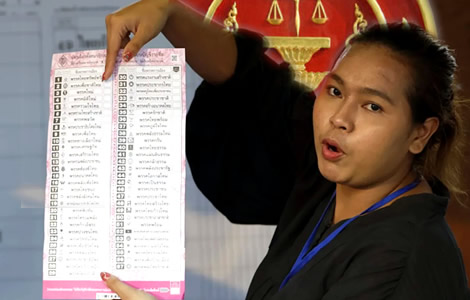
However, critics argue that the codes may allow traceability of votes. Opposition groups and petitioners say barcodes could work with ballot stubs. In conjunction, they argue, those records could link ballots to individuals. As a result, petitioners claim the secrecy of voting may be compromised.
Specifically, attention has centred on the party list pink ballot used in the poll. The barcode printed on that ballot has drawn the most scrutiny. Moreover, critics highlight post-election handling of materials as a key issue. Ballots with barcodes are normally stored together with ballot stubs. Counting documents are also kept alongside them after the election process.
Election Commission defends barcode as court limits review, but wider election challenges persist
Meanwhile, the Election Commission of Thailand has outlined its position on the dispute. The commission says barcodes and similar systems are used in other countries. Furthermore, it rejects claims that voters can be traced through the process.
According to the commission, identification would require illegal access to voting materials. Officials argue such actions would involve breaking the law. Nevertheless, the Ombudsman concluded there were sufficient grounds for judicial review.
After examining the gathered information, the office said constitutional concerns could not be dismissed. Therefore, the matter was forwarded to the court for a ruling.
Notably, the court’s current review is limited to barcode and secrecy issues. However, additional legal actions related to the election remain active. Some cases question the conduct of the poll itself. Others involve claims linked to tally seats and related disputes. Moreover, reports of anomalies in the election have circulated in recent weeks. Those matters are being pursued separately through legal channels. Consequently, the Feb 8 election continues to face scrutiny on several fronts.
Political pressure mounts as parties challenge election marks while the PM finalises his cabinet lineup
At the same time, political pressure has increased on election authorities. The People’s Party has filed a criminal misconduct complaint against the commission. According to the party, the move seeks legal clarity over identifying marks on ballots.
Specifically, it wants a detailed explanation of how those marks were used. Furthermore, the party indicated the issue could reach the Supreme Court. For now, however, the Constitutional Court review remains the central development.
Meanwhile, the governing camp is moving ahead with political plans. The Bhumjaithai Party and coalition partners are acting on the assumption that the election will stand. Therefore, preparations for cabinet formation are continuing. The swearing-in of ministers is expected in April. In addition, after Thursday, speculation in the Bangkok political world moves to seats at the cabinet table.
The general election result has left Prime Minister Anutin Charnvirakul in a strong and commanding position, with the Pheu Thai Party left fighting over its limited quota of cabinet positions.
Legal risks deepen as possible annulment threatens new government and raises cost of fresh poll
The People’s Party lies in opposition while also fighting legal fronts with the National Anti-Corruption Commission (NACC), which could see 44 of its most influential MPs barred from politics.
However, the court’s intervention has raised the stakes around the election outcome. If the judges conclude ballot secrecy was compromised, the consequences could be significant. In that scenario, the Feb 8 election results could be annulled.
Consequently, a new nationwide poll might be required under the constitution. Importantly, estimates place the cost of such an election at least 7 billion baht. That figure has been cited in discussions surrounding the case.
Former Justice Minister urges Election agency to act swiftly or risk February 8th poll being seen as fraud
Underfire People’s Party battles Election Commission over February 8 poll as it suffers blow after blow
Furthermore, the country would find itself in a constitutional crisis as the new government would be invalid.
For now, the legal process has entered its preliminary phase. The court has accepted the petition but has not ruled on its merits. Meanwhile, agencies and officials must prepare written explanations within the deadline. Those submissions will form the basis for further deliberation by the judges.
Until a ruling is issued, the election results remain in effect. Nevertheless, the barcode and QR code dispute has become a central political issue. Yet another Sword of Damocles hangs over an elected Thai government and Prime Minister.
Join the Thai News forum, follow Thai Examiner on Facebook here
Receive all our stories as they come out on Telegram here
Follow Thai Examiner here
Further reading:
Rising chance Feb 8th General Election will be voided as Ombudsman writes to the Election Commission
People’s Party and Pheu Thai Party call for Election Commission to back up Sunday’s election outcome
Outcry as anomalies and errors detected in Sunday’s General Election. Spontaneous protests break out
Trade expert warns the government on barter deals with China being pursued by the Commerce Ministry
Top Commerce Ministry official warns that any US trade deal must wait for new parliament and cabinet
Asean Summit on Monday and Tuesday seen by United States as pivotal to restoring border peace
War to continue says PM Anutin. Dismisses President Trump’s ceasefire talk as a ‘misunderstanding’
;